Uluṟu-Kata Tjuṯa National Park, Australia | Longitude 131°
Longitude 131°: Australia’s Iconic Desert Lodge at Uluṟu
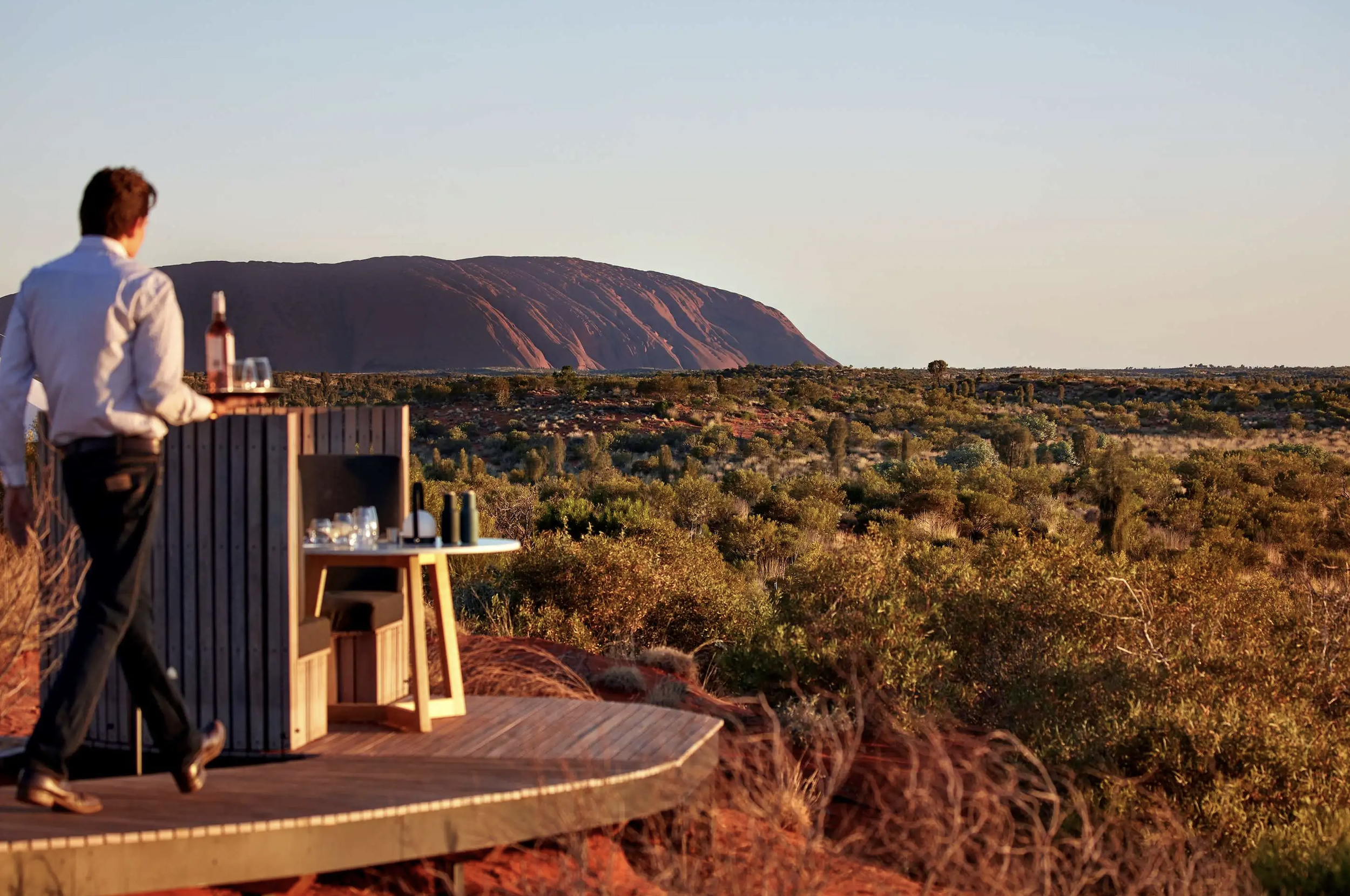
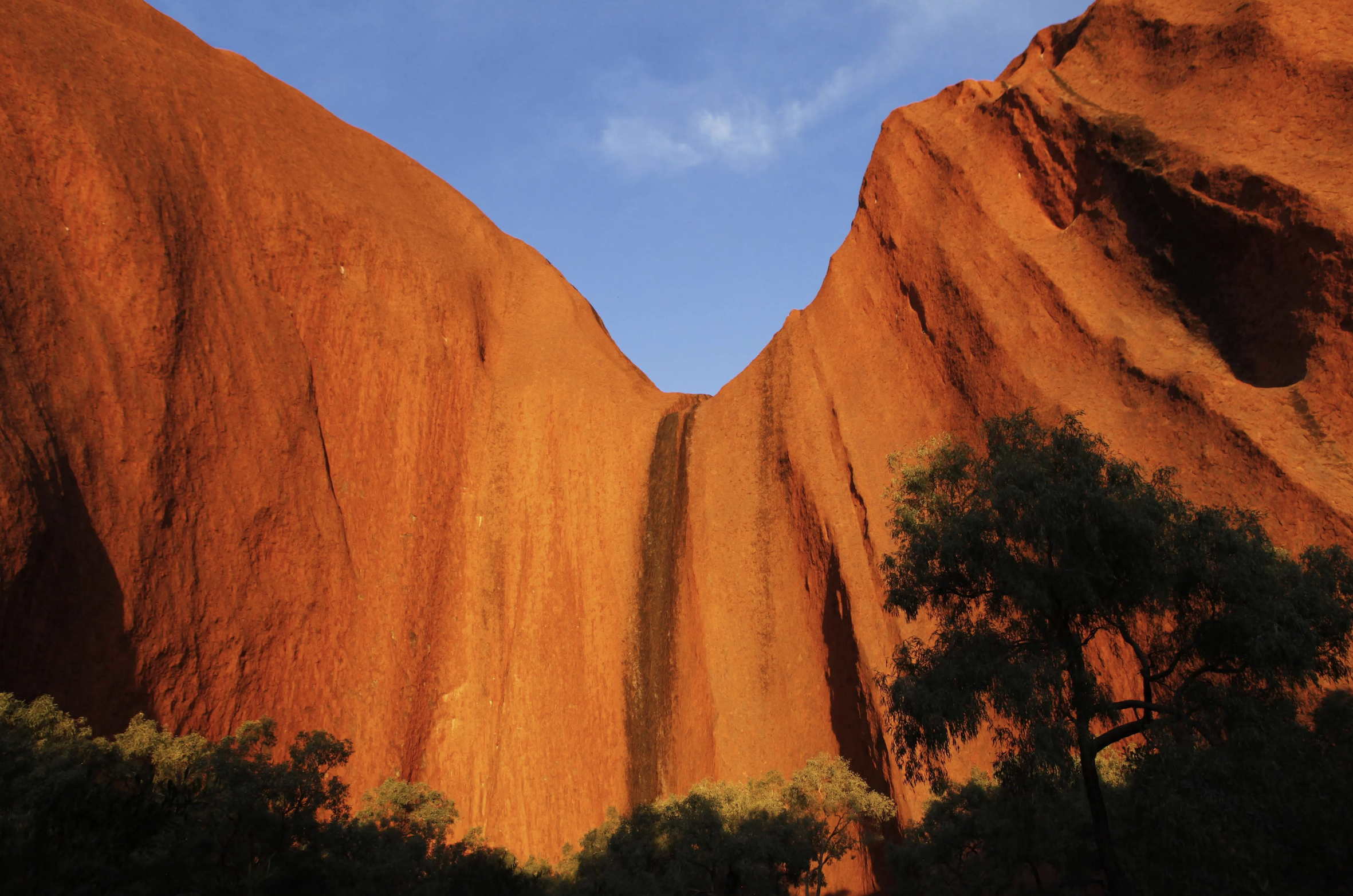
There are few landscapes as immediately recognizable as Uluṟu. Rising from the red earth of Australia’s Central Desert, the sandstone monolith has become one of the defining images of the country, but seeing it in person reveals something photographs rarely capture. Its appearance changes throughout the day, shifting from muted ochre in the early morning to increasingly intense shades of orange and red as the sun moves across the desert.
At Longitude 131°, that landscape is not something guests travel to see each day. It is there from the moment they wake up.
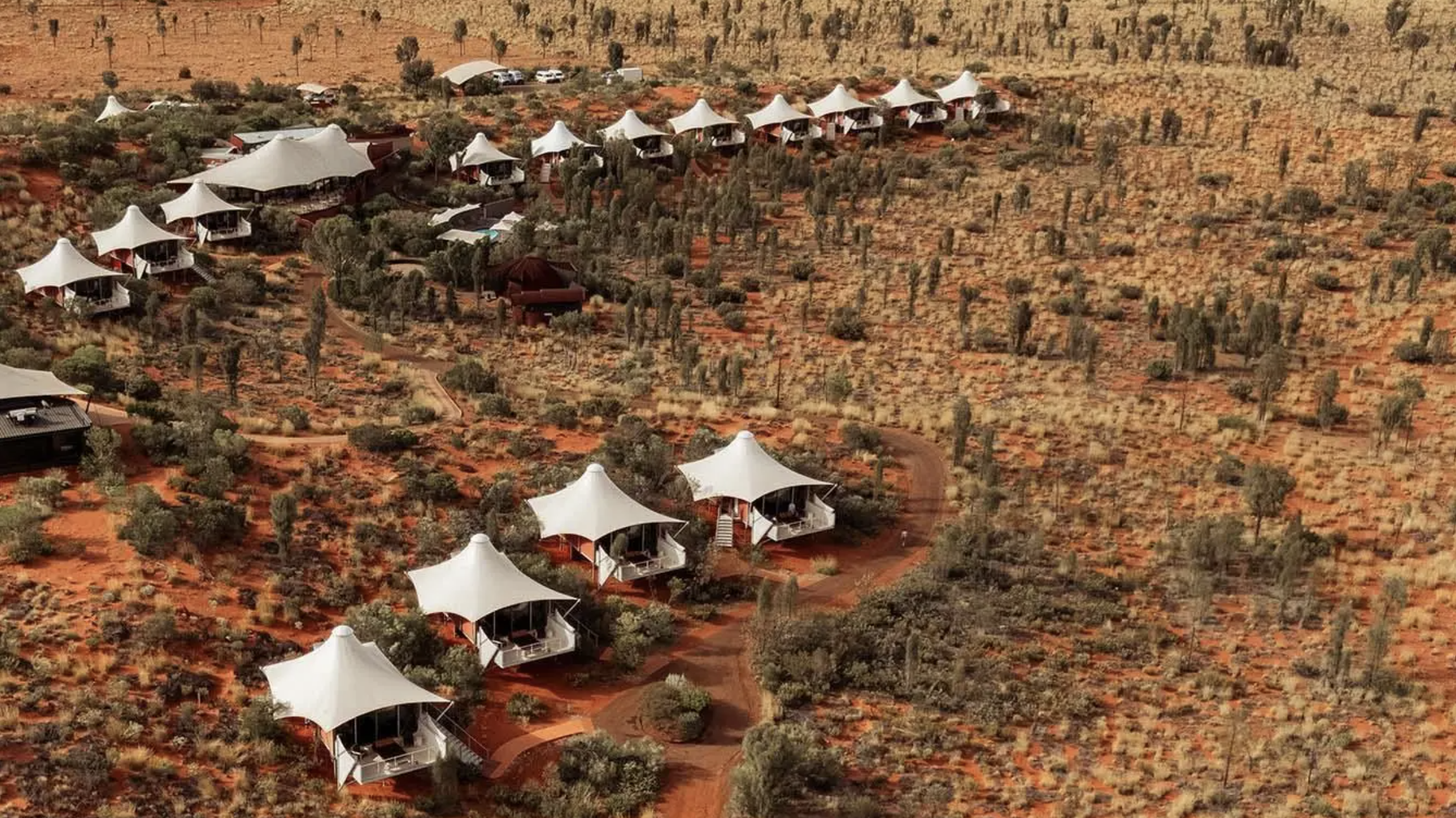
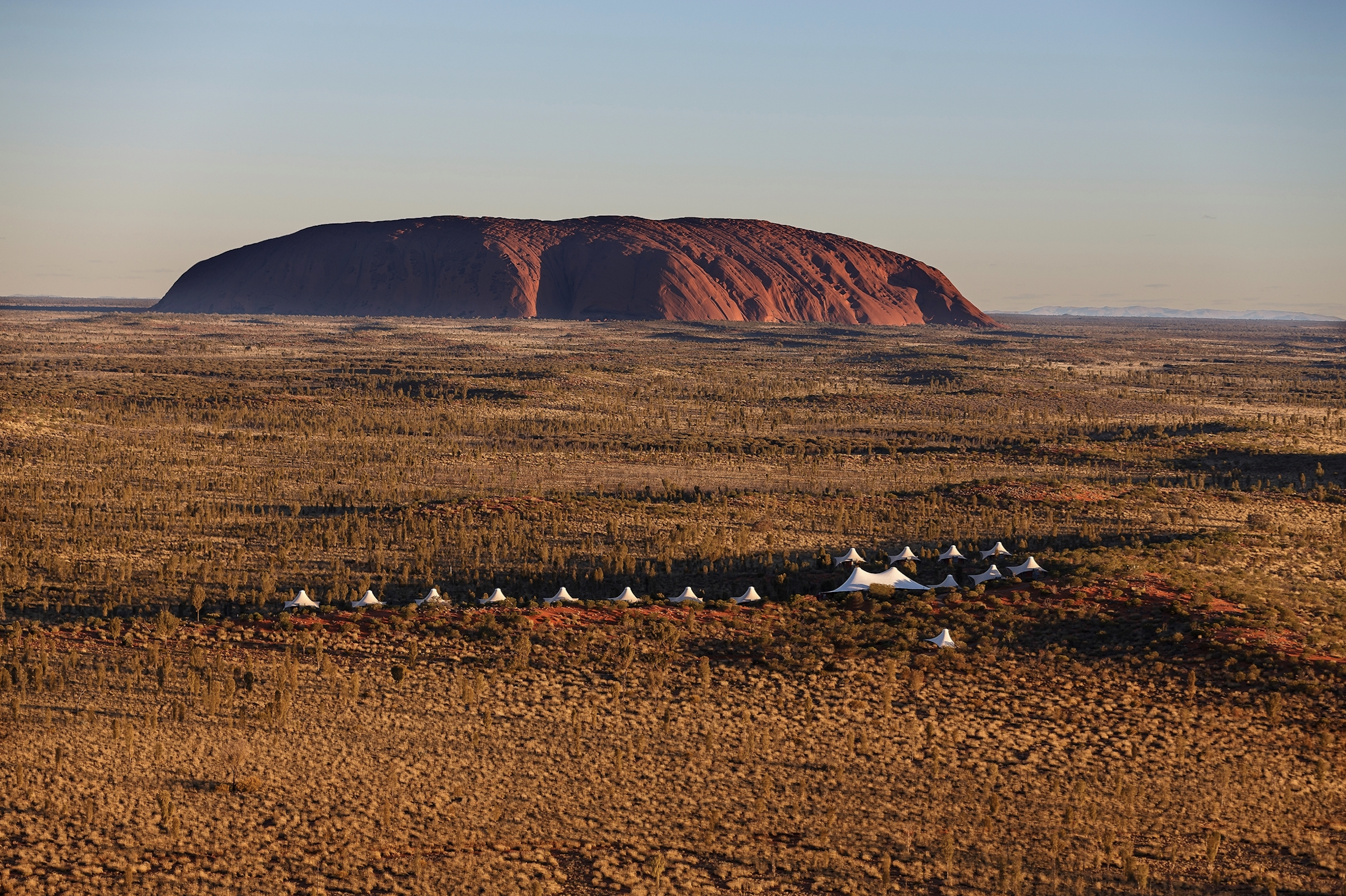
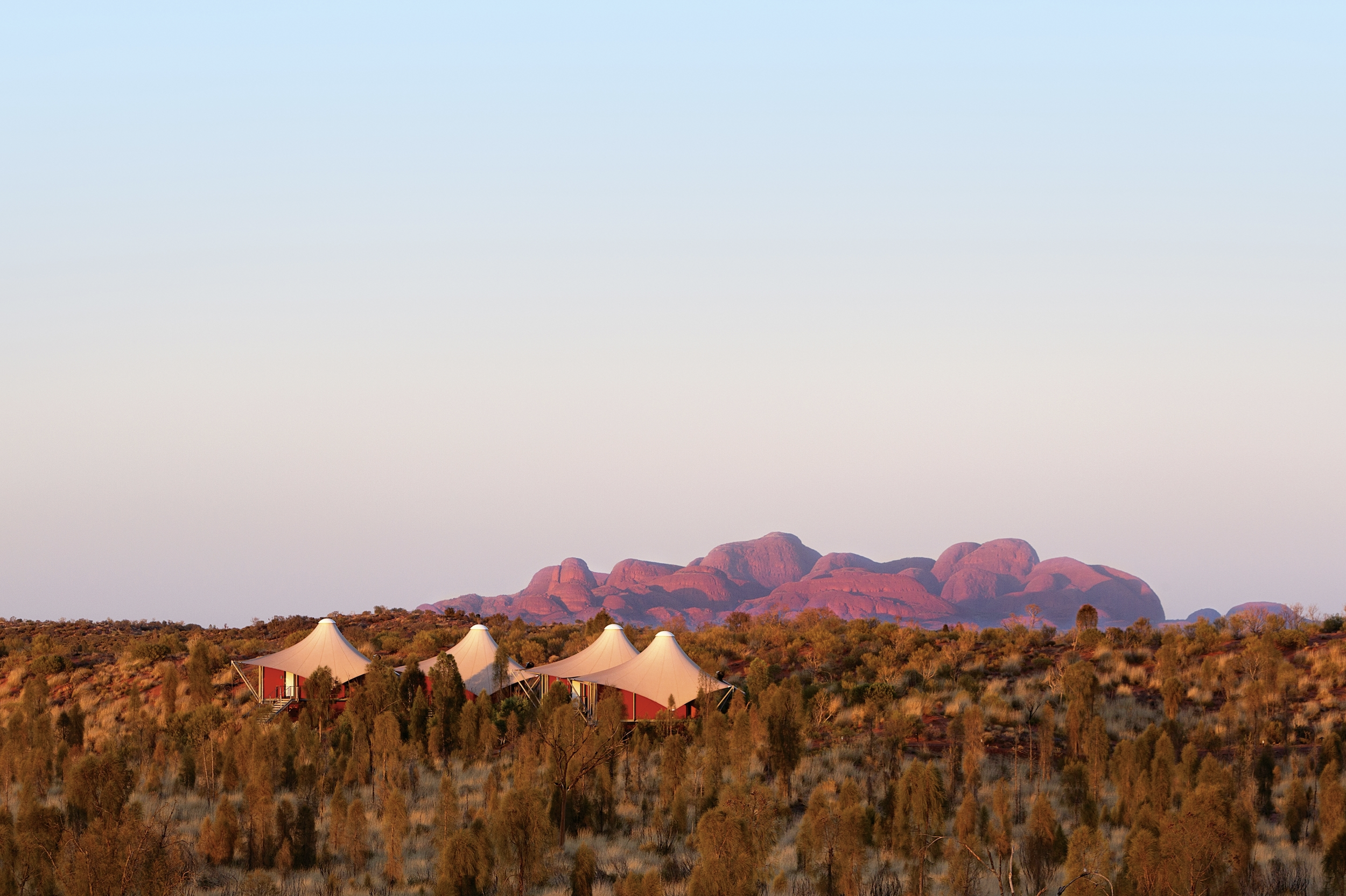
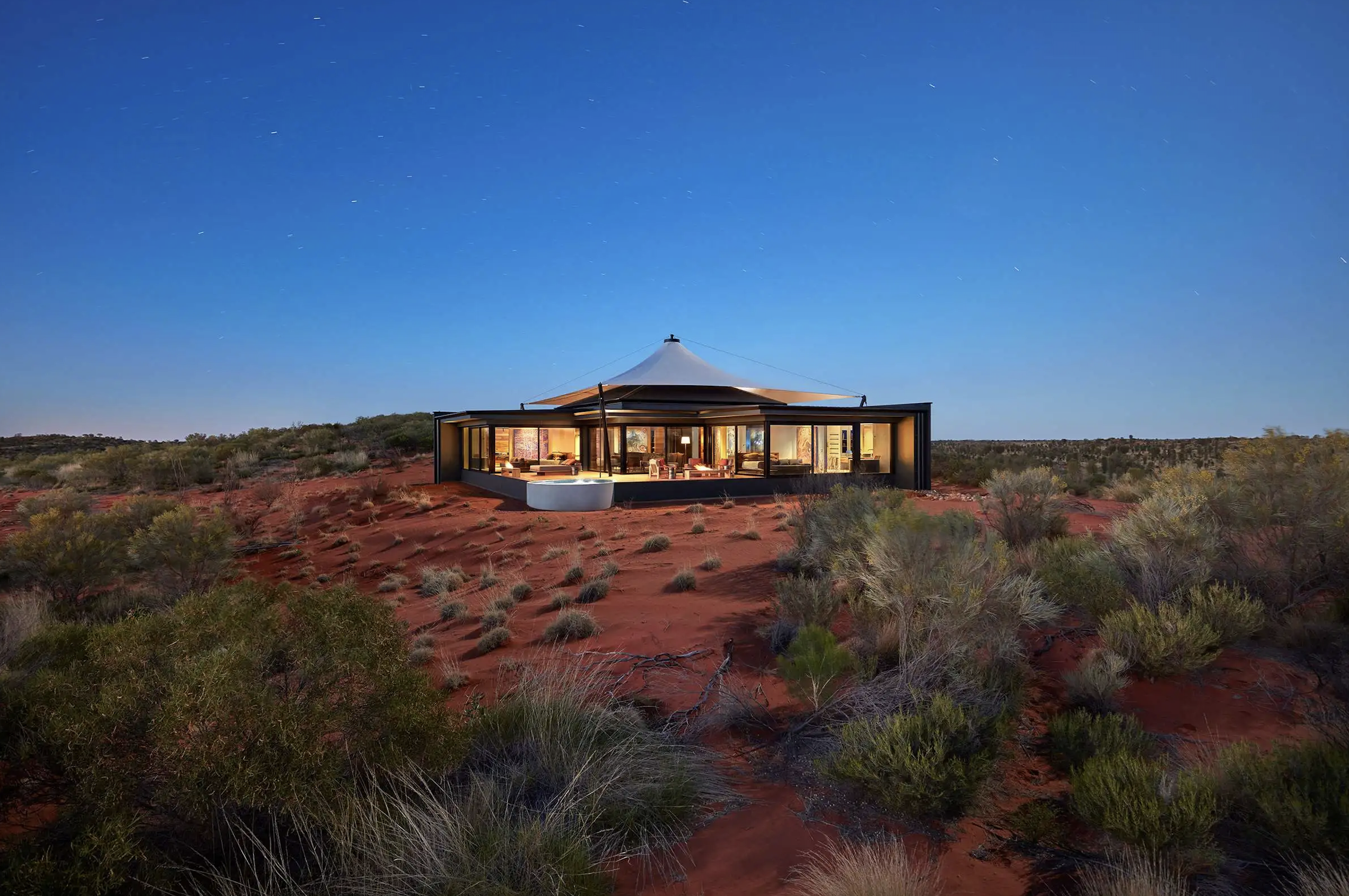
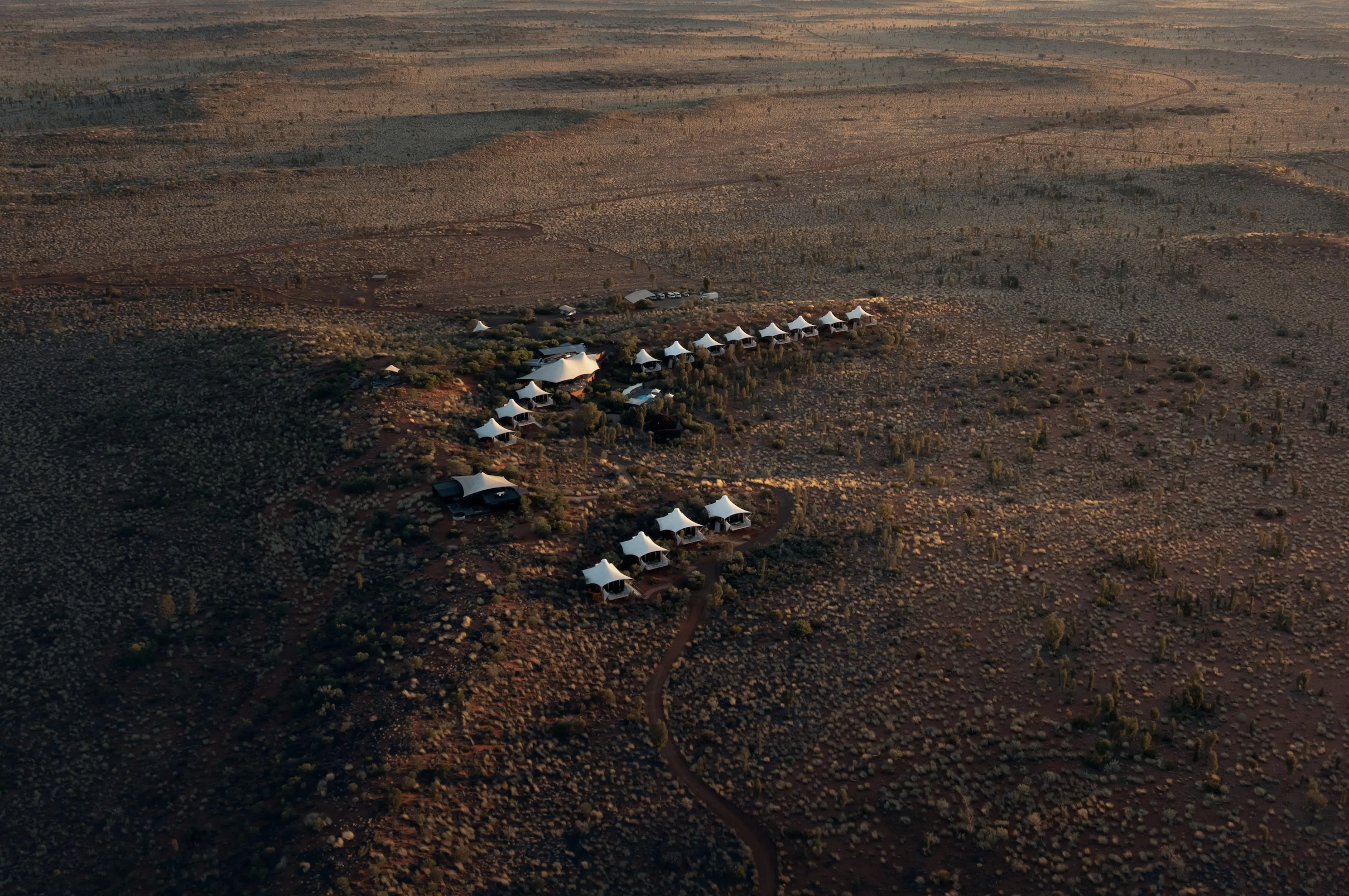
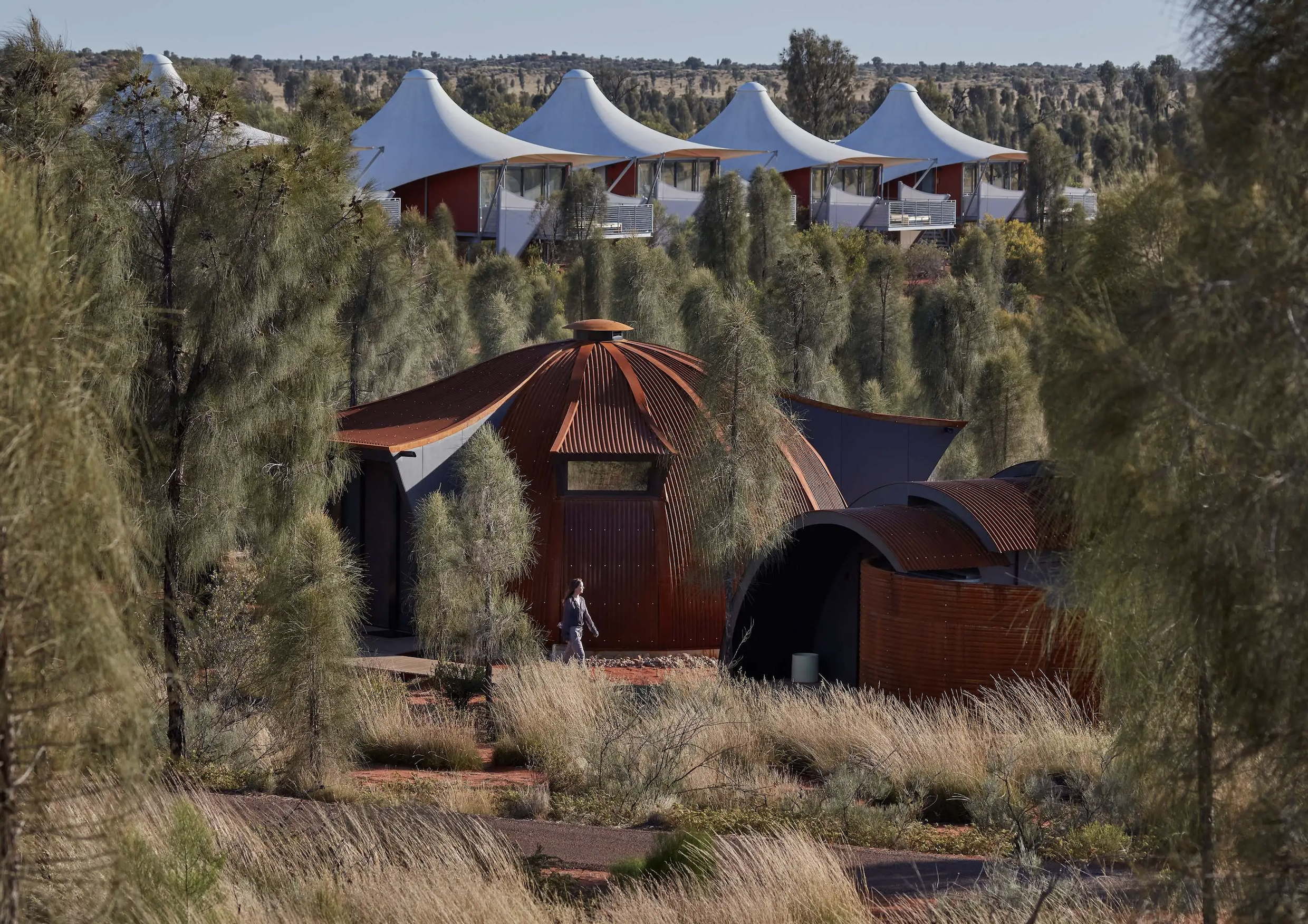
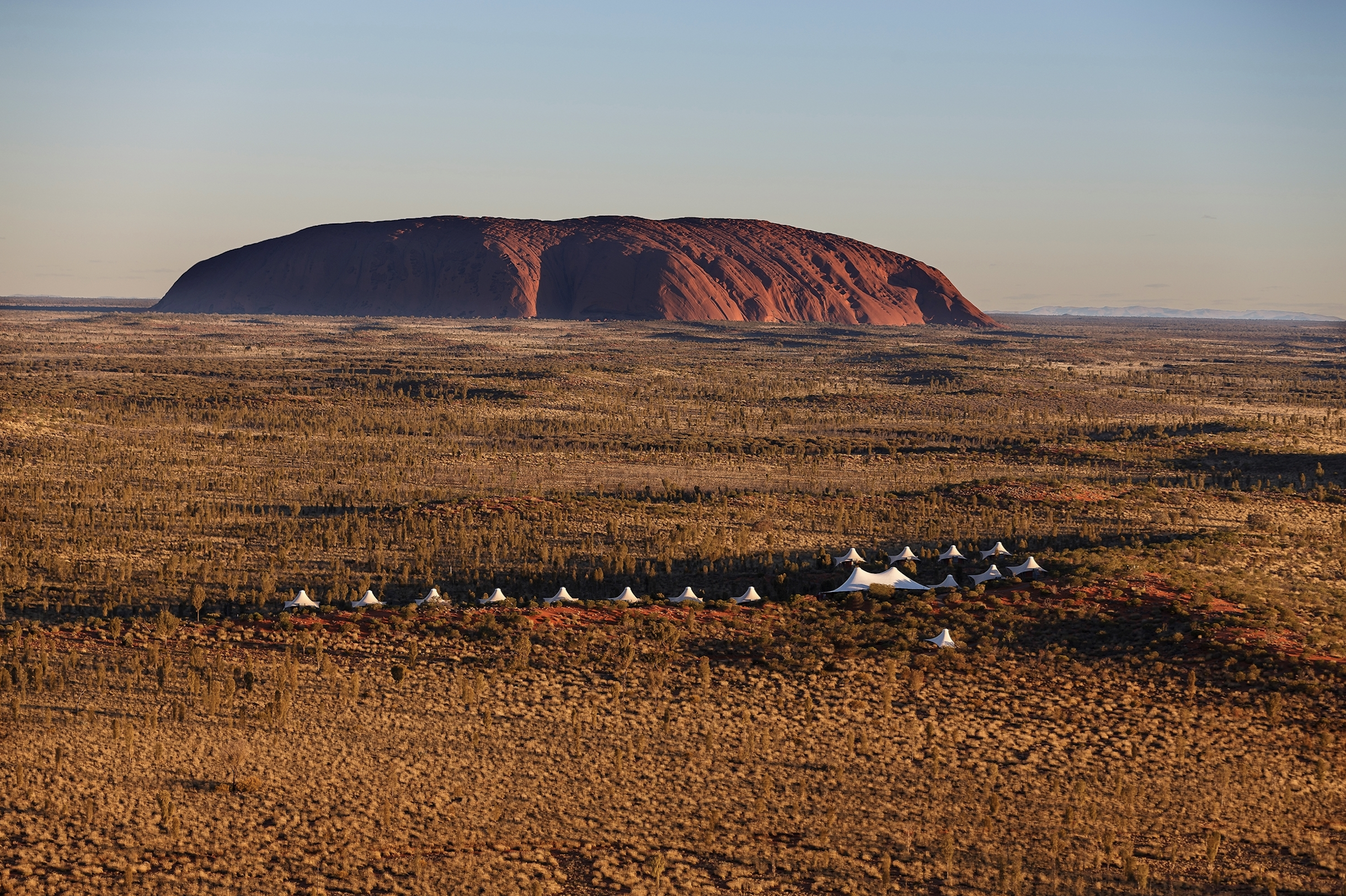
Located among the dunes near Uluṟu-Kata Tjuṯa National Park in Australia's Northern Territory, Longitude 131° is a collection of just 16 tented pavilions overlooking one of the country's most significant natural and cultural landscapes. Fifteen Luxury Tents are arranged across the desert with views toward Uluṟu, while the two-bedroom Dune Pavilion occupies an especially privileged position with sightlines toward both Uluṟu and Kata Tjuṯa.
The lodge is deliberately small, but the experience extends far beyond the accommodations. Days are built around guided exploration of Uluṟu-Kata Tjuṯa National Park, sunrise walks, sunsets in the desert, Indigenous art and culture, and evenings beneath some of the clearest skies in Australia. Meals, beverages, airport transfers, and a selection of signature guided experiences are included in the stay, allowing Longitude 131° to operate as both accommodation and a carefully considered introduction to the Red Centre.
For travelers making the considerable journey into Australia's interior, that distinction matters. Longitude 131° is not simply somewhere to stay near Uluṟu. The lodge has been designed around experiencing the destination itself.
A Landscape with a History Far Older Than Australia
Understanding Longitude 131° begins with understanding where it stands.
Uluṟu-Kata Tjuṯa National Park is Aṉangu land, and Aṉangu have always lived here. Uluṟu and Kata Tjuṯa are inseparable from Tjukurpa, the foundation of Aṉangu law, culture, knowledge, relationships, and responsibilities to Country.
The significance of the landscape therefore extends far beyond its geology or appearance.
European exploration of the region came much later. Explorer Ernest Giles recorded seeing Kata Tjuṯa in 1872, while William Gosse became the first recorded non-Aboriginal visitor to reach Uluṟu in 1873, naming it Ayers Rock after Sir Henry Ayers, then Chief Secretary of South Australia.
Tourism developed gradually during the twentieth century. An access road was constructed in 1948 as interest in visiting Uluṟu increased, and the area was declared Ayers Rock National Park in 1950. Kata Tjuṯa was later incorporated into what became Ayers Rock-Mount Olga National Park.
The relationship between tourism, conservation, and Traditional Ownership would undergo profound change.
On October 26, 1985, title to Uluṟu-Kata Tjuṯa was formally returned to its Aṉangu Traditional Owners in the event now known as Handback. Today, the land is owned by Aṉangu and leased to the Director of National Parks, with the park jointly managed through a board with an Aṉangu majority.
In 1993, the official name became Uluṟu-Kata Tjuṯa National Park. The following year, the park became only the second place in the world at the time to receive World Heritage recognition for both its natural and cultural values.
That context is essential to any visit.
Longitude 131° incorporates it throughout the guest experience through guided excursions, Indigenous art, relationships with Aboriginal arts communities, and interpretation of the landscape. The intention is not simply to photograph Uluṟu, but to leave with a better understanding of why this place carries such importance.
From Desert Camp to Australian Lodge Icon
Longitude 131° first opened in 2002, introducing an architectural concept radically different from conventional resort development in the Red Centre.
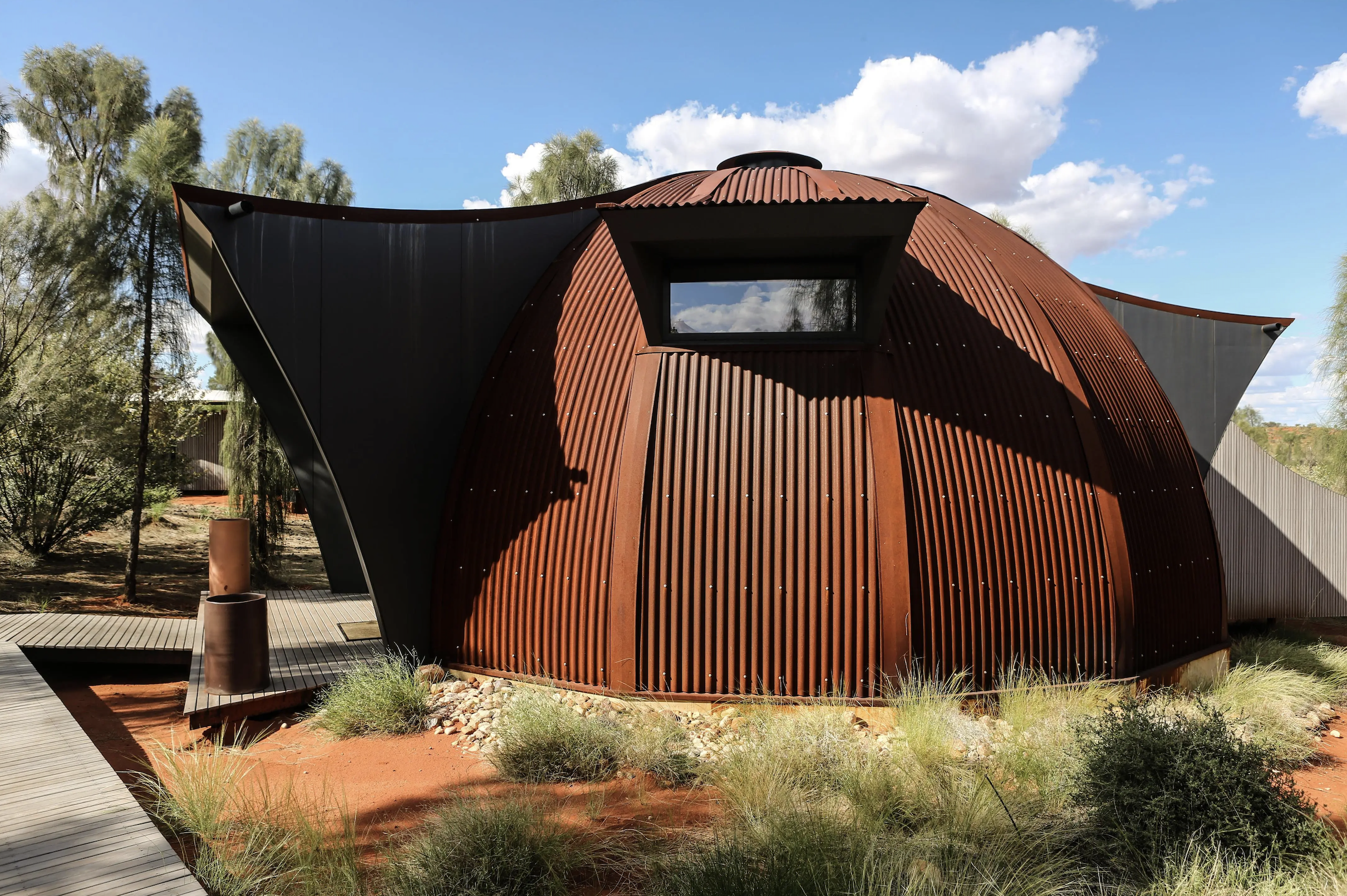
Leading Australian architect Philip Cox conceived a collection of elevated safari-style pavilions gathered around a central Dune House. The structures were designed to sit lightly within the fragile desert environment while orienting the entire experience toward Uluṟu.
The original concept established much of what still defines Longitude 131° today: a small number of tented accommodations, uninterrupted engagement with the landscape, and architecture that remains secondary to what surrounds it.
A new chapter began in November 2013 when Longitude 131° joined the Baillie Lodges portfolio.
James and Hayley Baillie had already developed a distinctive approach to Australian experiential travel through properties including Southern Ocean Lodge on Kangaroo Island and Capella Lodge on Lord Howe Island. At Longitude 131°, they began a series of enhancements intended to retain Philip Cox's original concept while making the lodge more connected to its setting, Australian design, Indigenous art, and the style of hospitality for which Baillie Lodges had become known.
Guest tents received new interiors and furnishings, followed by expansive private balconies designed by South Australian architect Max Pritchard. Each introduced a daybed, outdoor seating, and fireplace, creating an entirely new way for guests to experience the desert from their own pavilion.
A larger transformation completed in 2017 expanded that vision considerably. Max Pritchard Gunner Architects worked with the Baillies on the Dune Pavilion, Spa Kinara, Dune Top, redesigned lodge spaces, swimming pool, and further improvements throughout the property.
The result is a lodge that has evolved considerably since 2002 without losing the simplicity of its original idea.
The landscape still comes first.
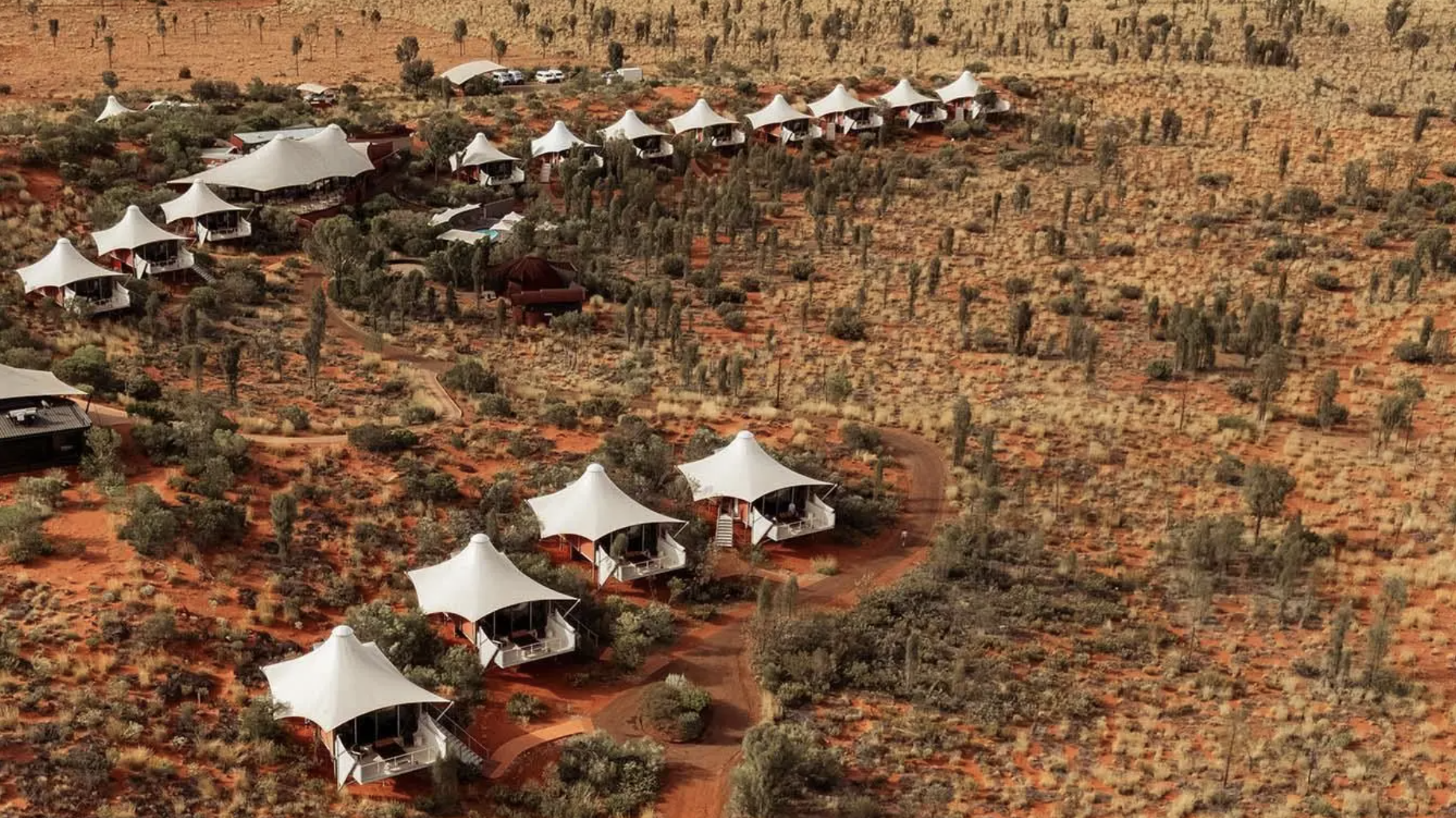
Architecture That Knows When to Disappear
Longitude 131° is visually distinctive, yet much of its success comes from architecture that deliberately avoids competing with Uluṟu.
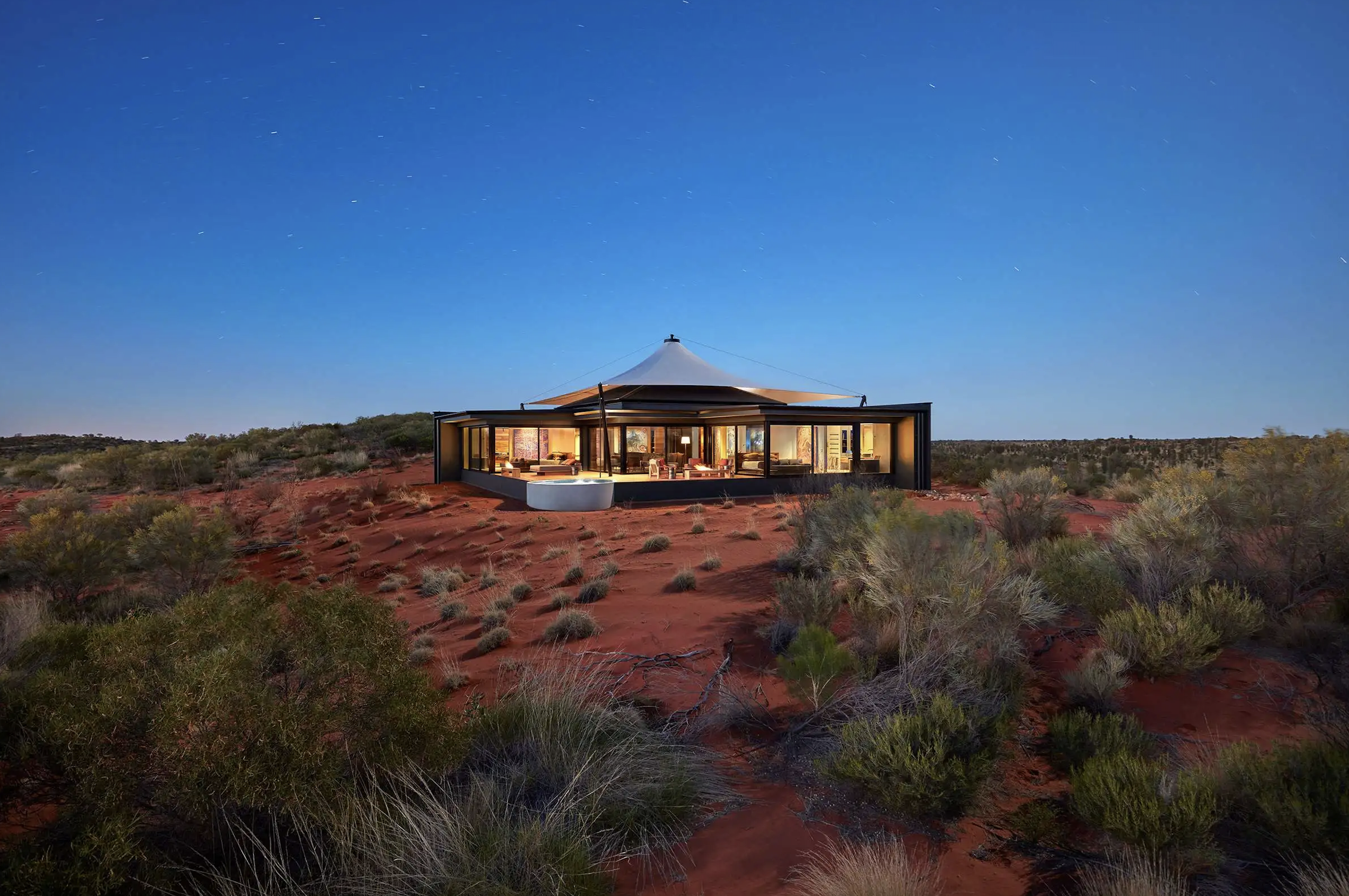
The white tented roofs reference traditional expedition camps, while elevated structures minimize disturbance to the desert beneath them. The lodge's environmentally sensitive construction incorporates renewable energy, and its structures were designed with the ability to ultimately be dismantled and removed, allowing the dunes to be restored.
Inside, the safari reference becomes more refined.
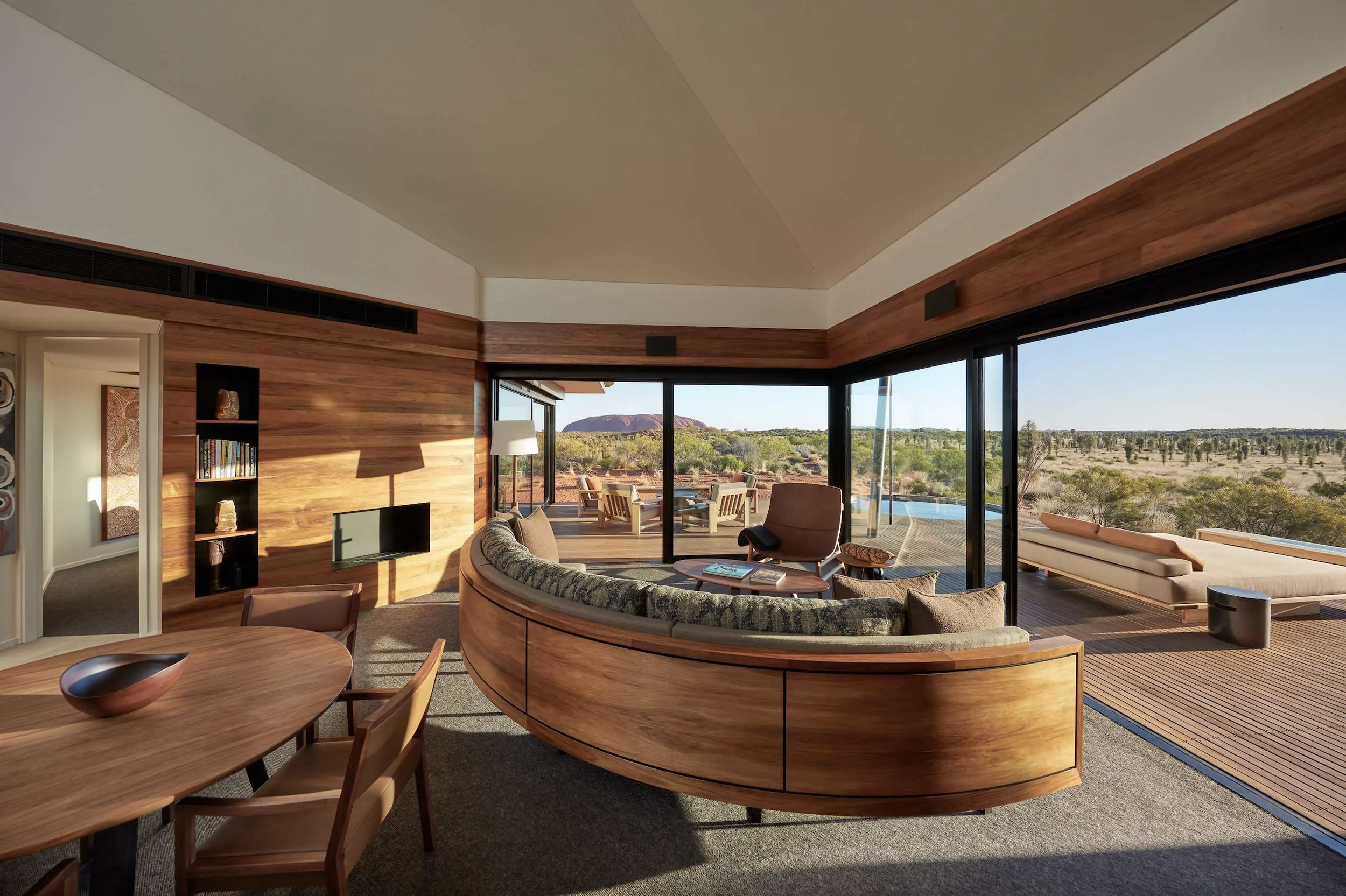
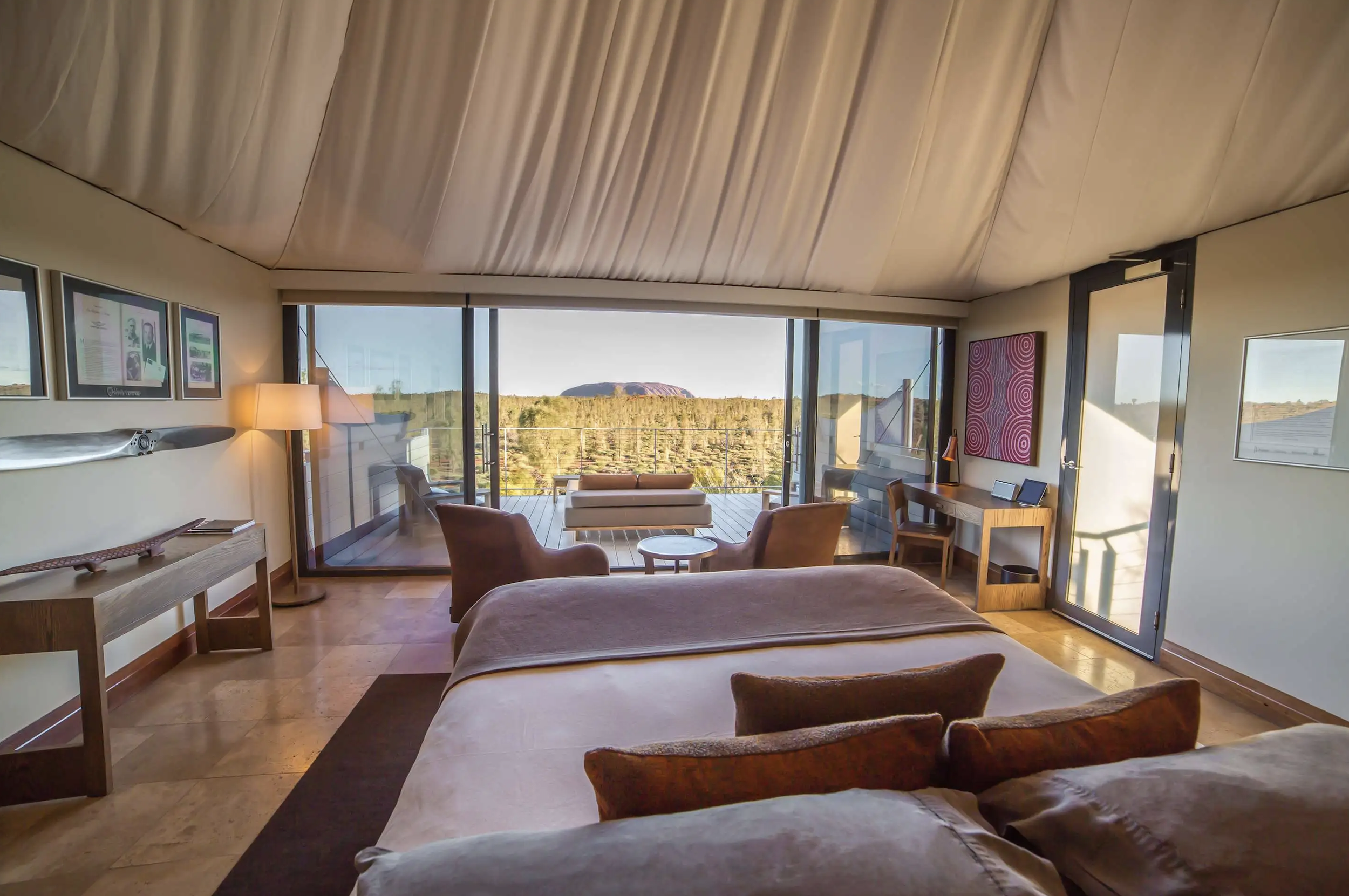
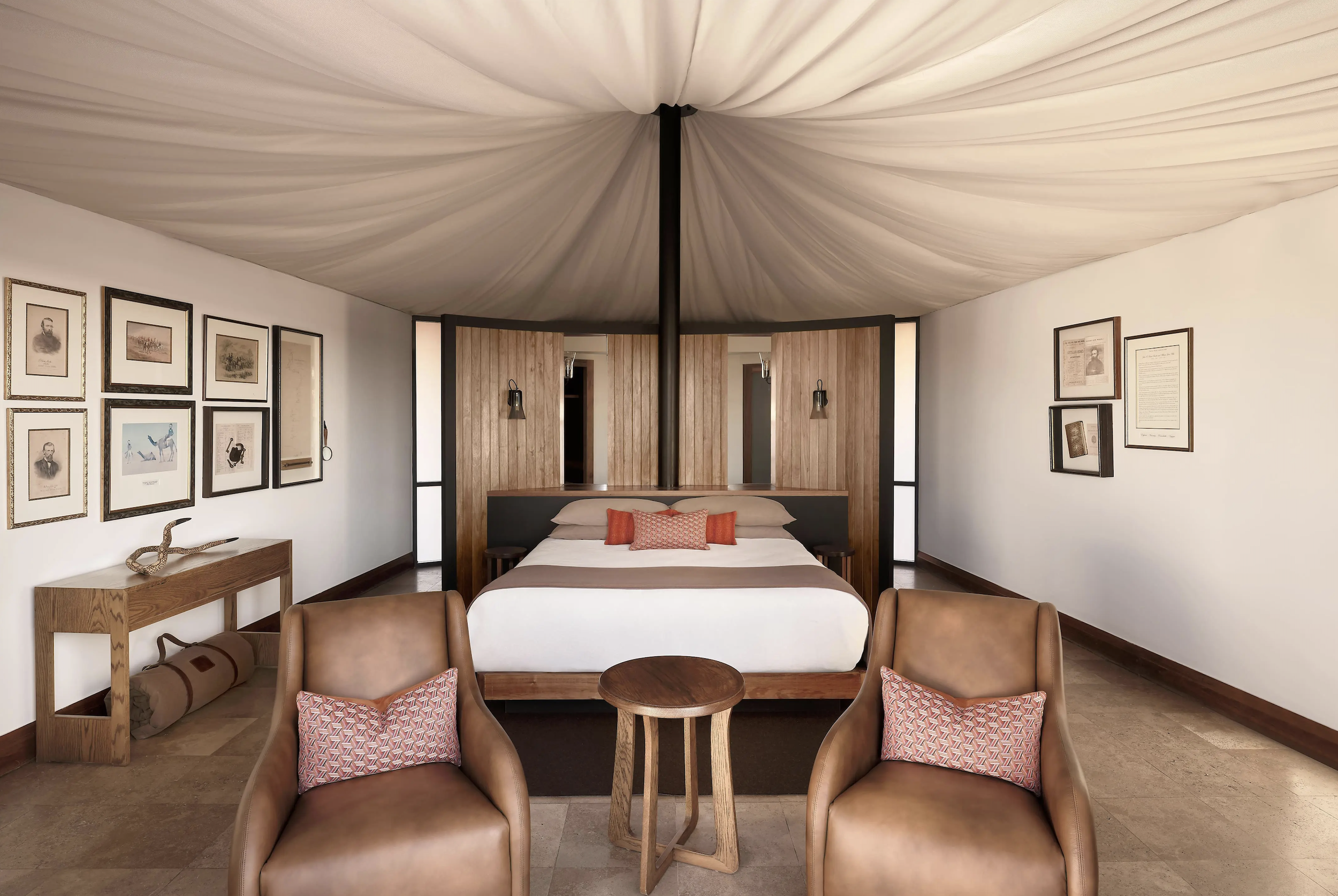
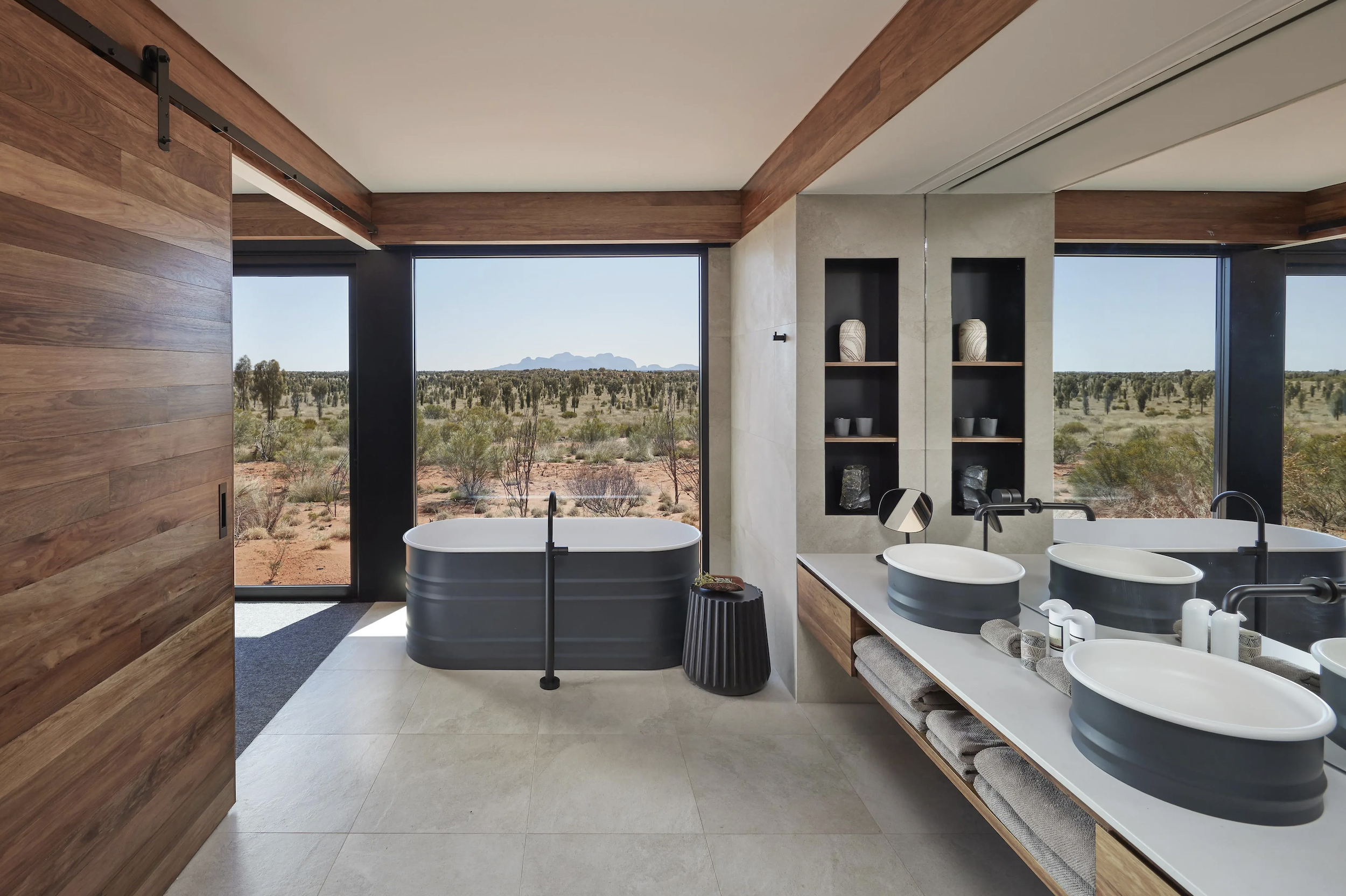
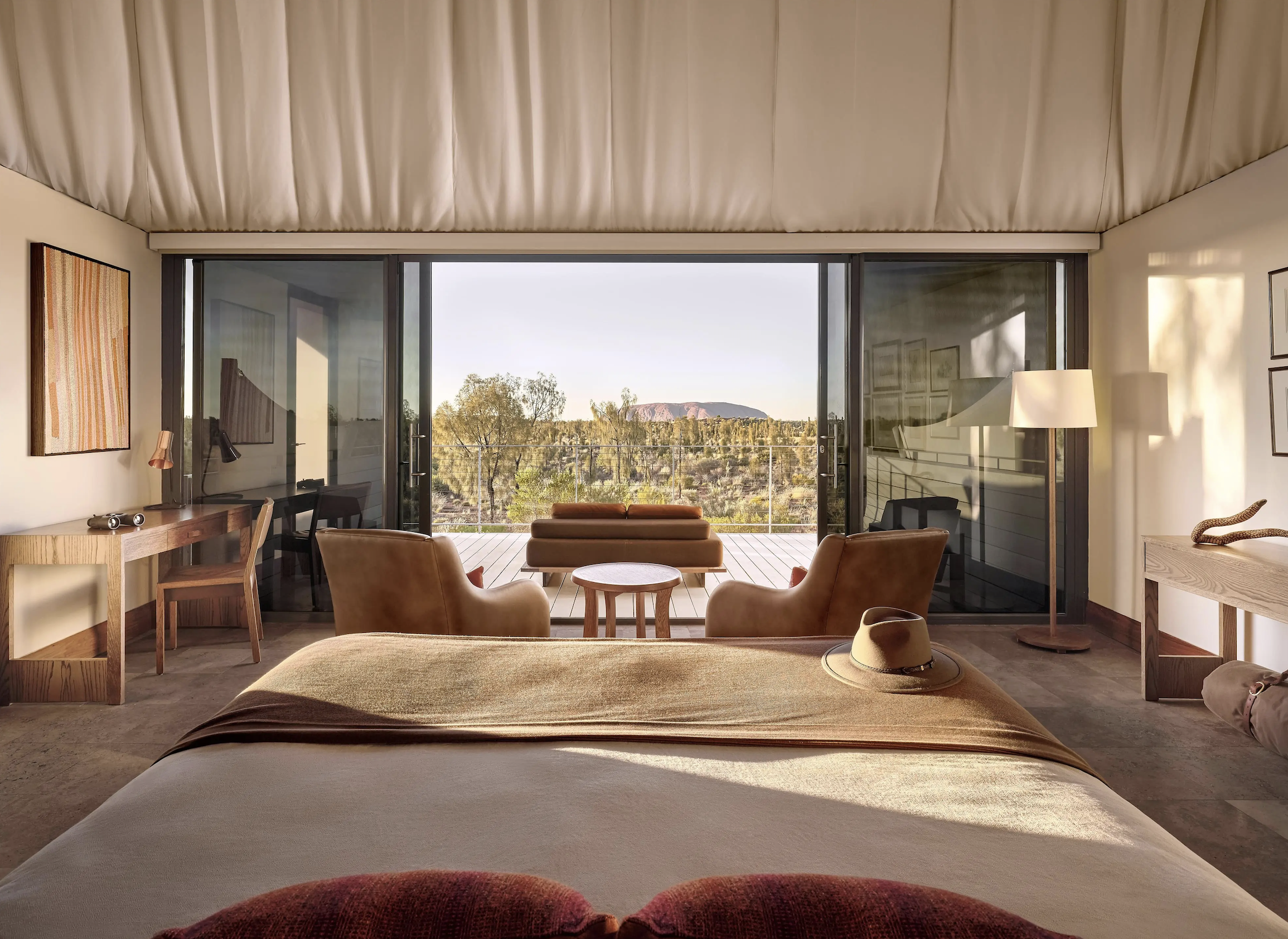
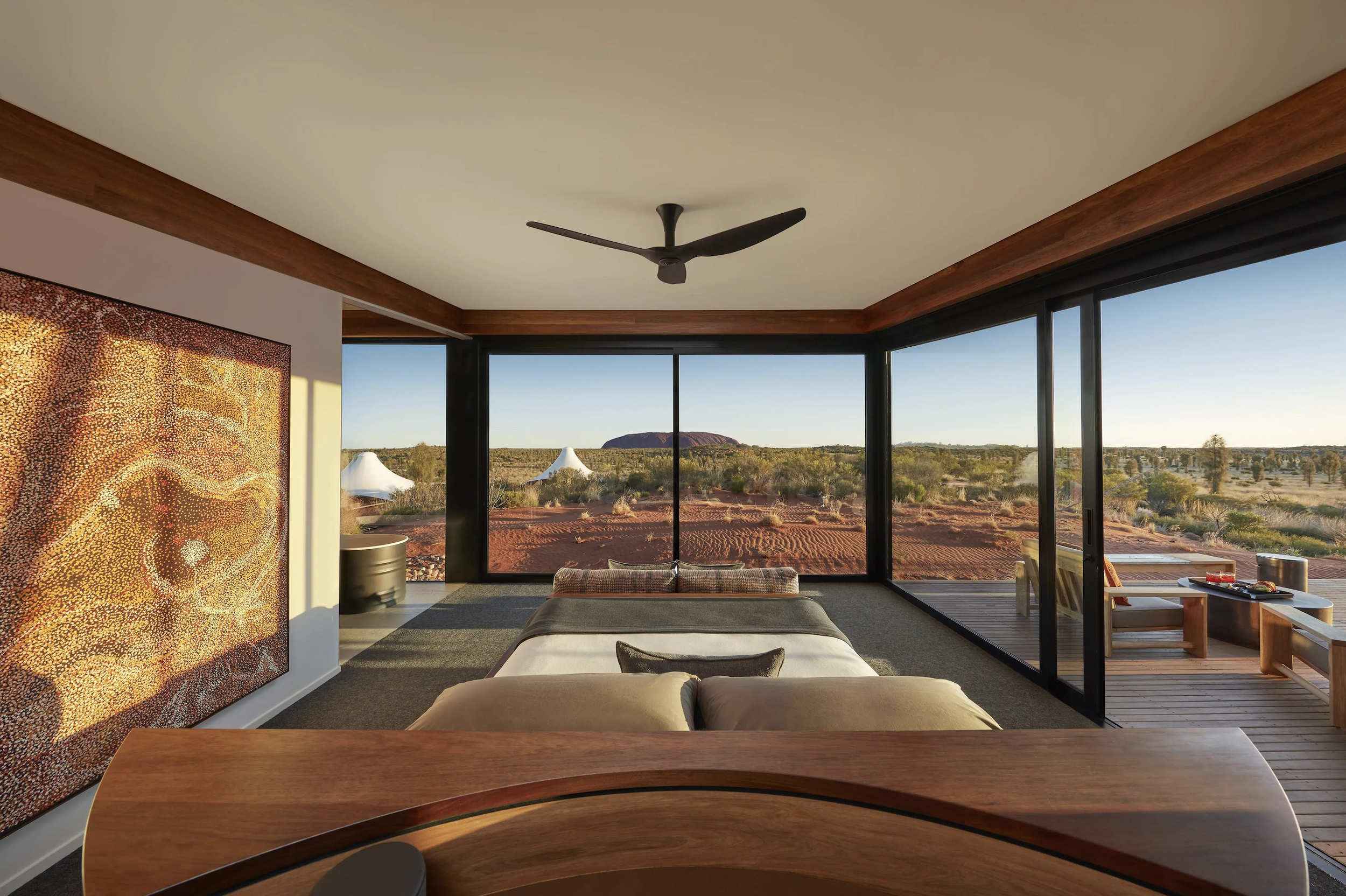
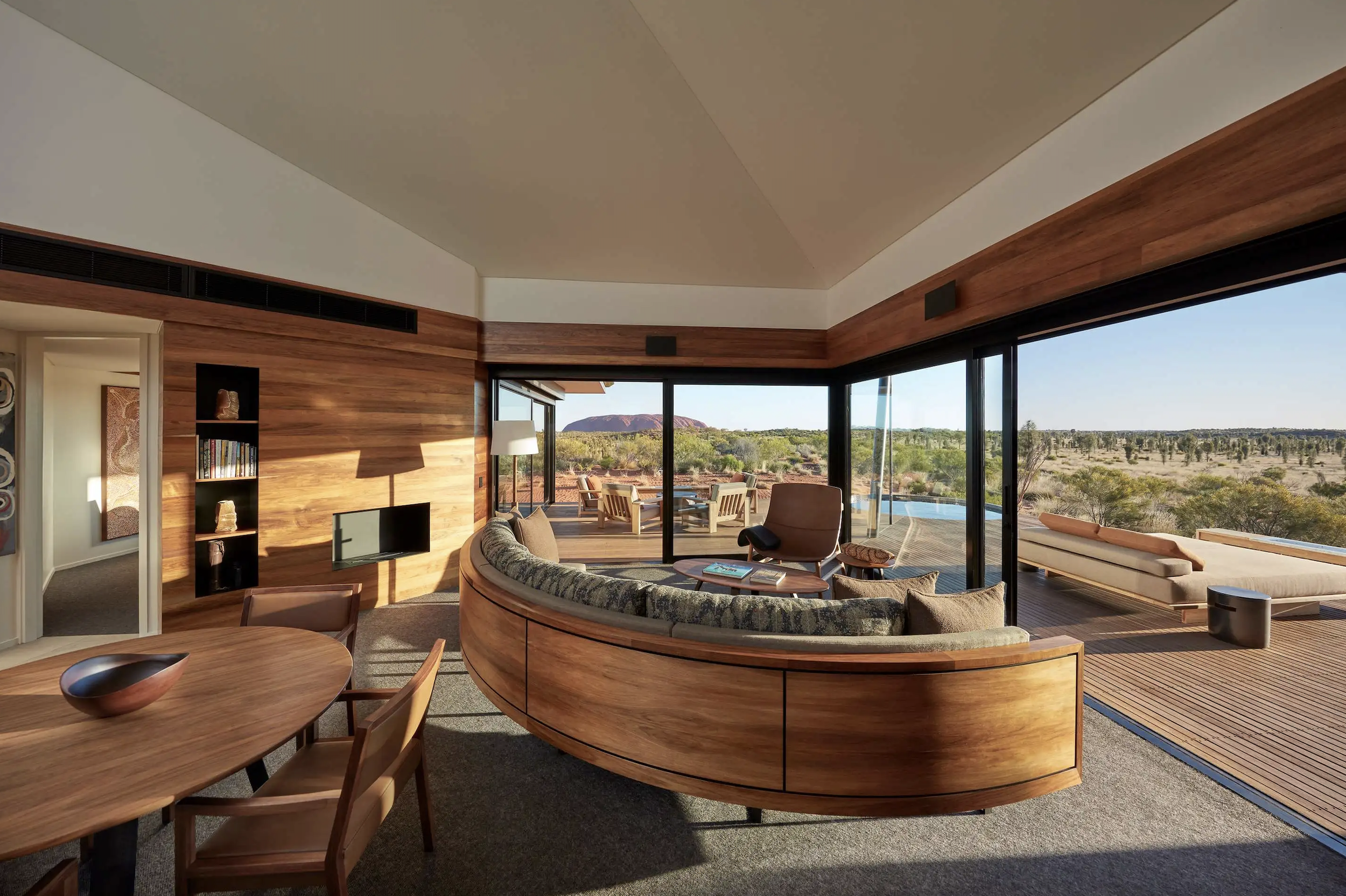
Australian timbers, leather, natural fabrics, custom furniture, fireplaces, and contemporary Australian design give the accommodations warmth without separating them from the environment. Floor-to-ceiling glass places Uluṟu directly in front of the bed, while outdoor decks extend the living space into the desert.
Indigenous art has become equally important to the lodge's identity.
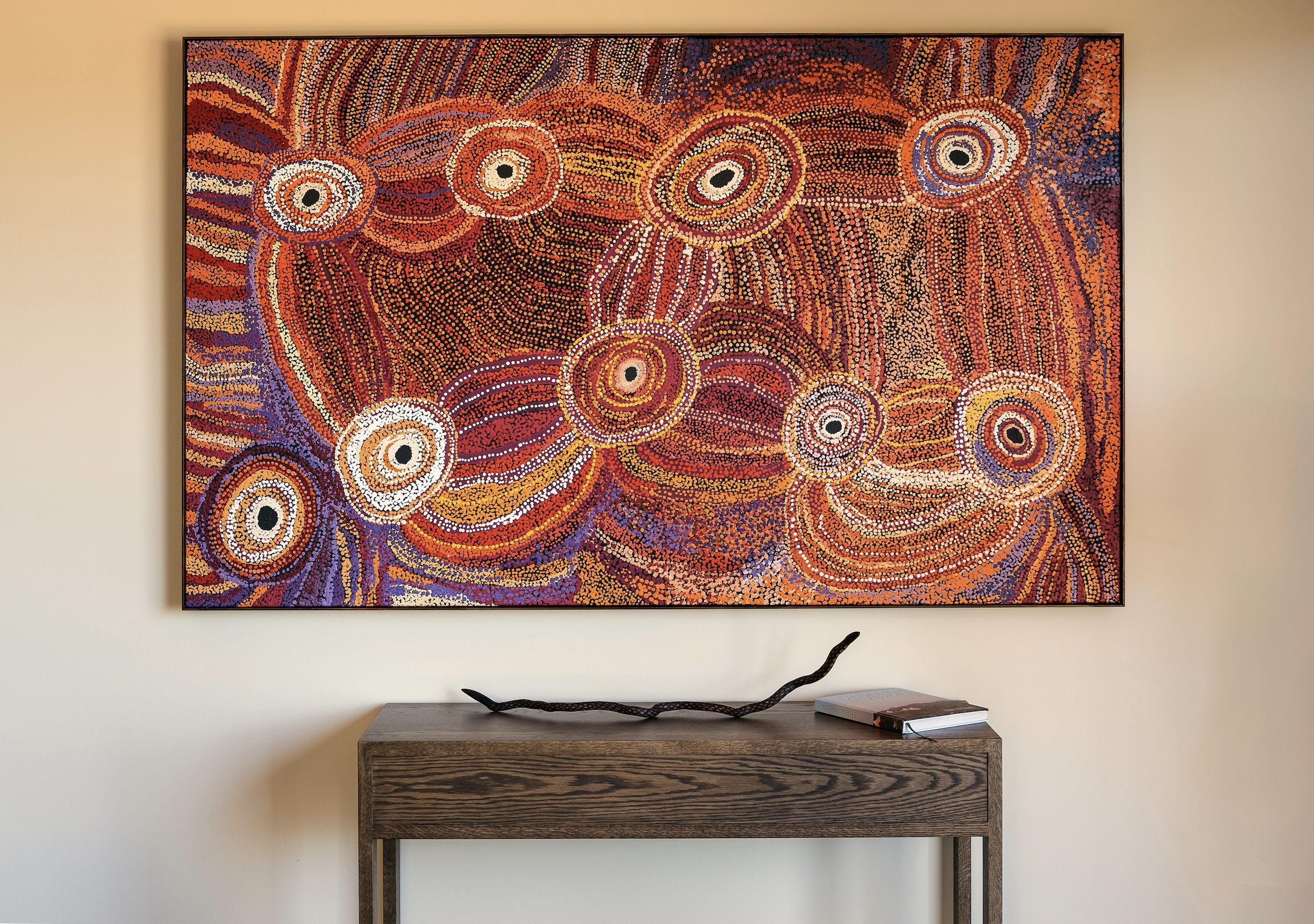
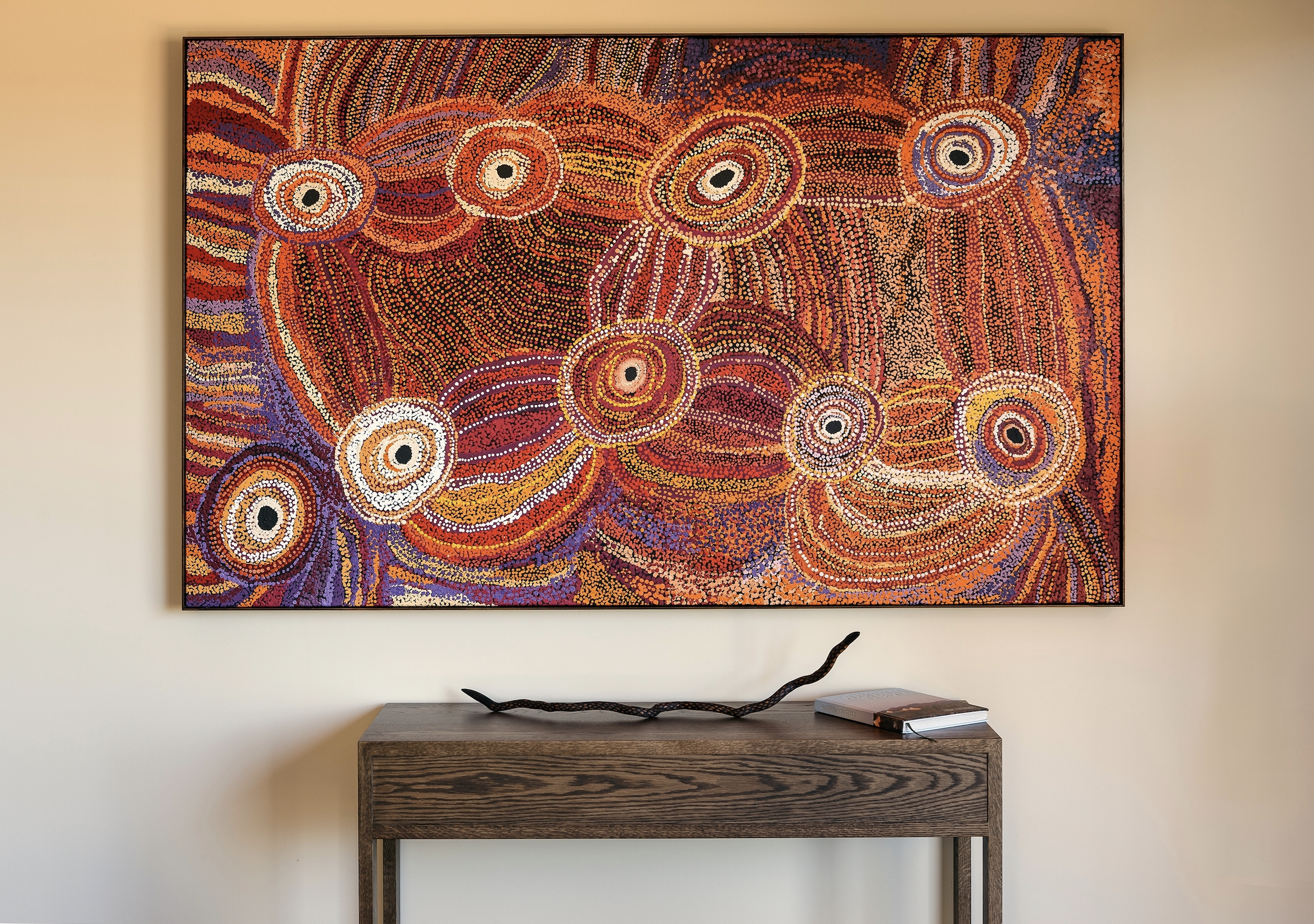
Longitude 131° works with several Aboriginal arts communities, with paintings, ceramics, woven pieces, woodwork, and other works displayed throughout the property. Its particularly close relationship with Ernabella Arts in the Aṉangu Pitjantjatjara Yankunytjatjara Lands has developed into an ongoing partnership that includes commissioned works and artists-in-residence programs.
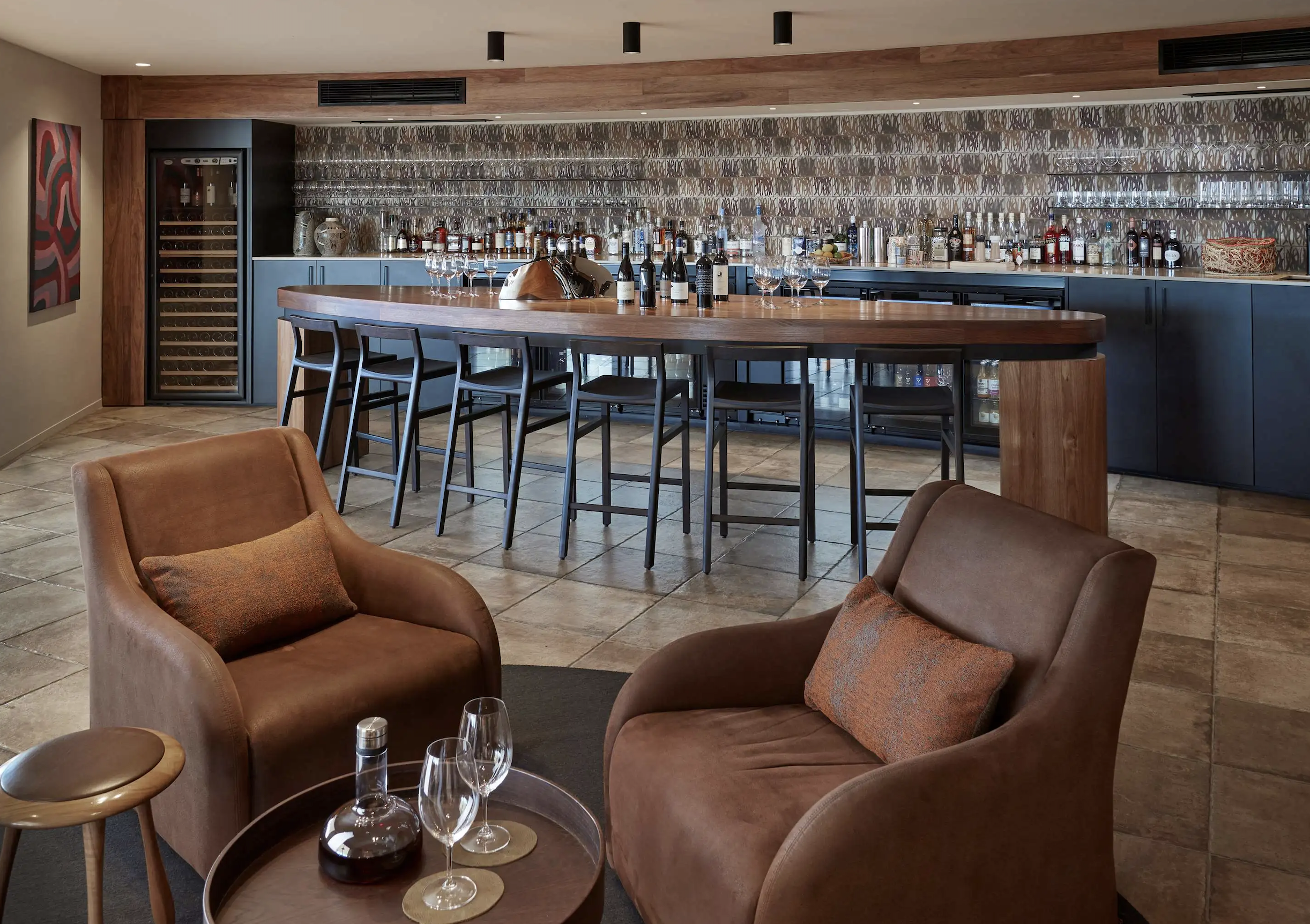
In the Dune House, hundreds of individually painted ceramic tiles created by Ernabella artists form a distinctive installation behind the bar. Works by First Nations artists continue throughout the guest pavilions and public spaces, placing contemporary expressions of living culture alongside references to Australia's early European explorers.
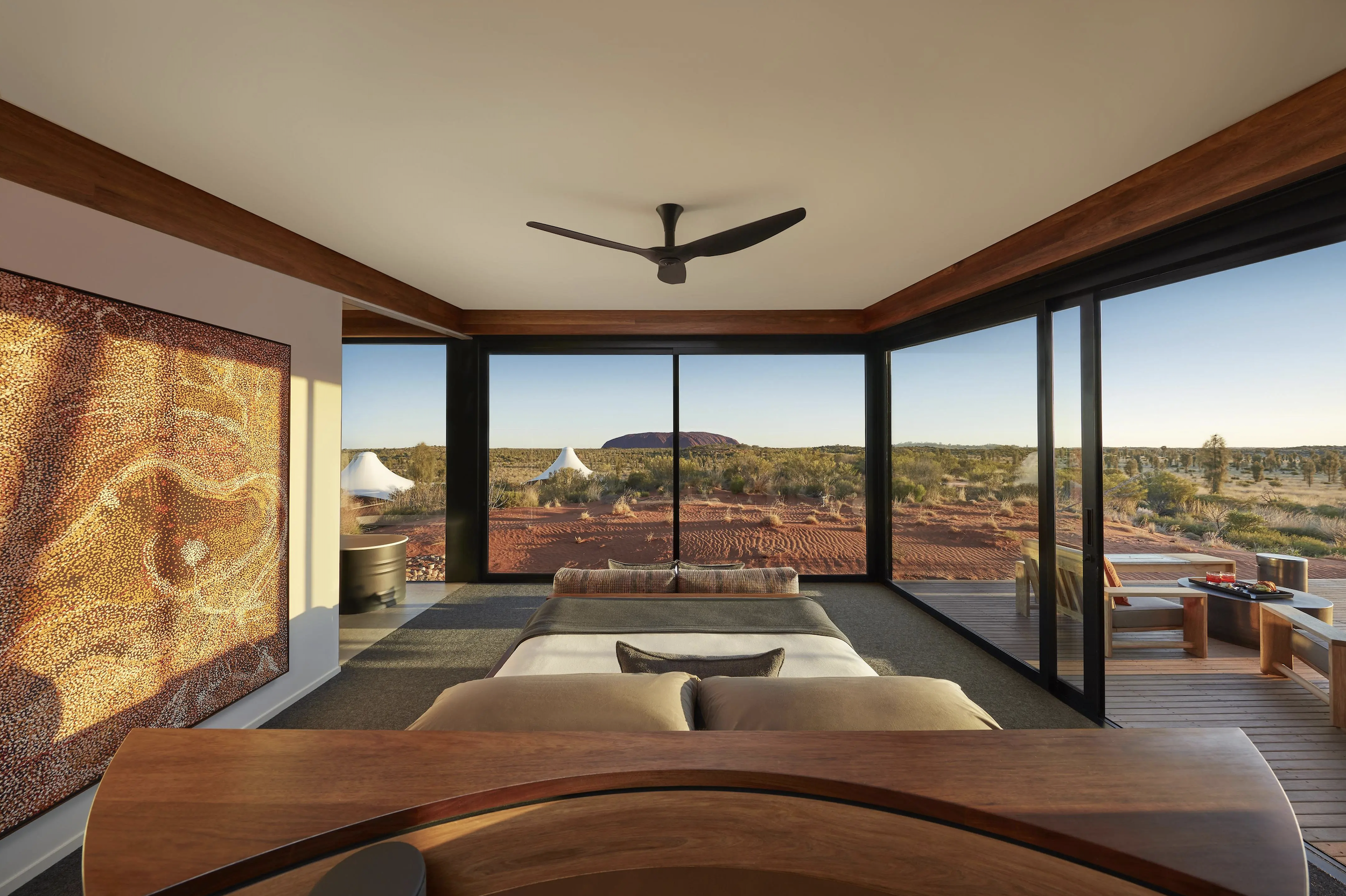
The Dune Pavilion takes the architectural concept further. Designed as a contemporary Australian homestead, its interiors incorporate Australian Blackwood, custom furniture, expansive glass, and broad outdoor spaces that open toward both Uluṟu and Kata Tjuṯa.
The result avoids the anonymity that can sometimes accompany remote luxury camps. Longitude 131° feels unmistakably Australian and, more specifically, connected to the Central Desert.
Sixteen Pavilions Facing the Desert
Longitude 131° comprises 15 one-bedroom Luxury Tents and the larger two-bedroom Dune Pavilion, with a selection of the standard tents designated as Premium View accommodations. Each pavilion has been designed around the surrounding desert, with floor-to-ceiling glass, First Nations artworks, Australian furnishings, and outdoor living spaces.
Luxury Tent: Approximately 678 square feet (63 square meters) of indoor and outdoor living space, with a king or twin bed, ensuite rain shower, fireplace, private balcony with daybed, and direct views toward Uluṟu.
Luxury Tent Premium View: Approximately 678 square feet (63 square meters), combining the same tented design, First Nations artworks, king or twin bedding, ensuite rain shower, fireplace, and private balcony with an especially favorable uninterrupted outlook toward Uluṟu.
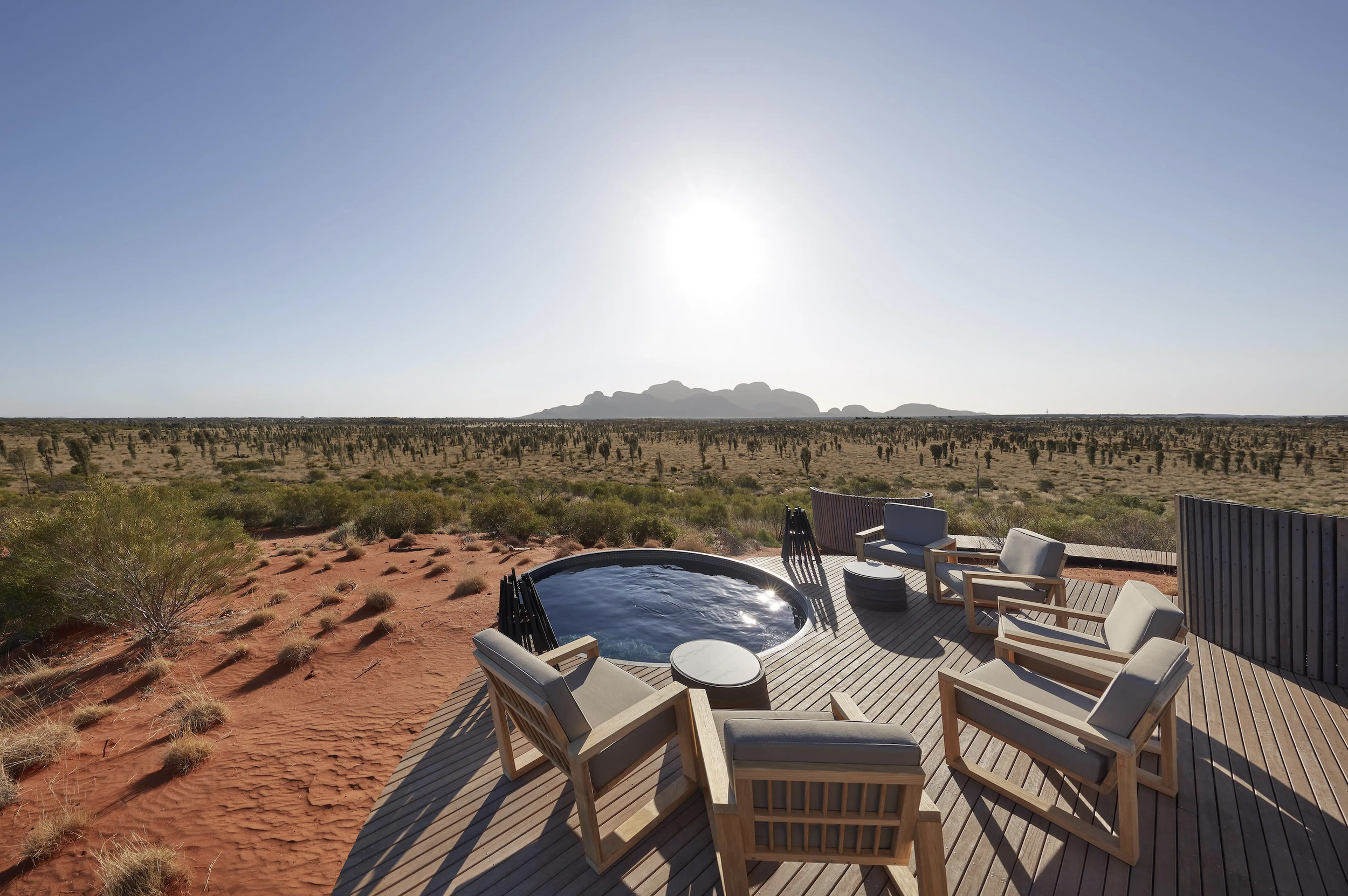
Dune Pavilion: Approximately 1,647 square feet (153 square meters), with two private bedrooms and ensuites, a separate living area, expansive outdoor deck, fireplace, private plunge pool, and the lodge's only accommodation offering views toward both Uluṟu and Kata Tjuṯa.
The Luxury Tents are substantial enough that the word “tent” can be misleading. They function more like standalone desert suites beneath a canopied roof, with climate control, proper bathrooms, custom furniture, stocked in-room bars, and generous outdoor living spaces.
Still, the most important feature is the one no interior designer could create. Open the curtains in the morning and Uluṟu is already there.
Contemporary Australia on the Table
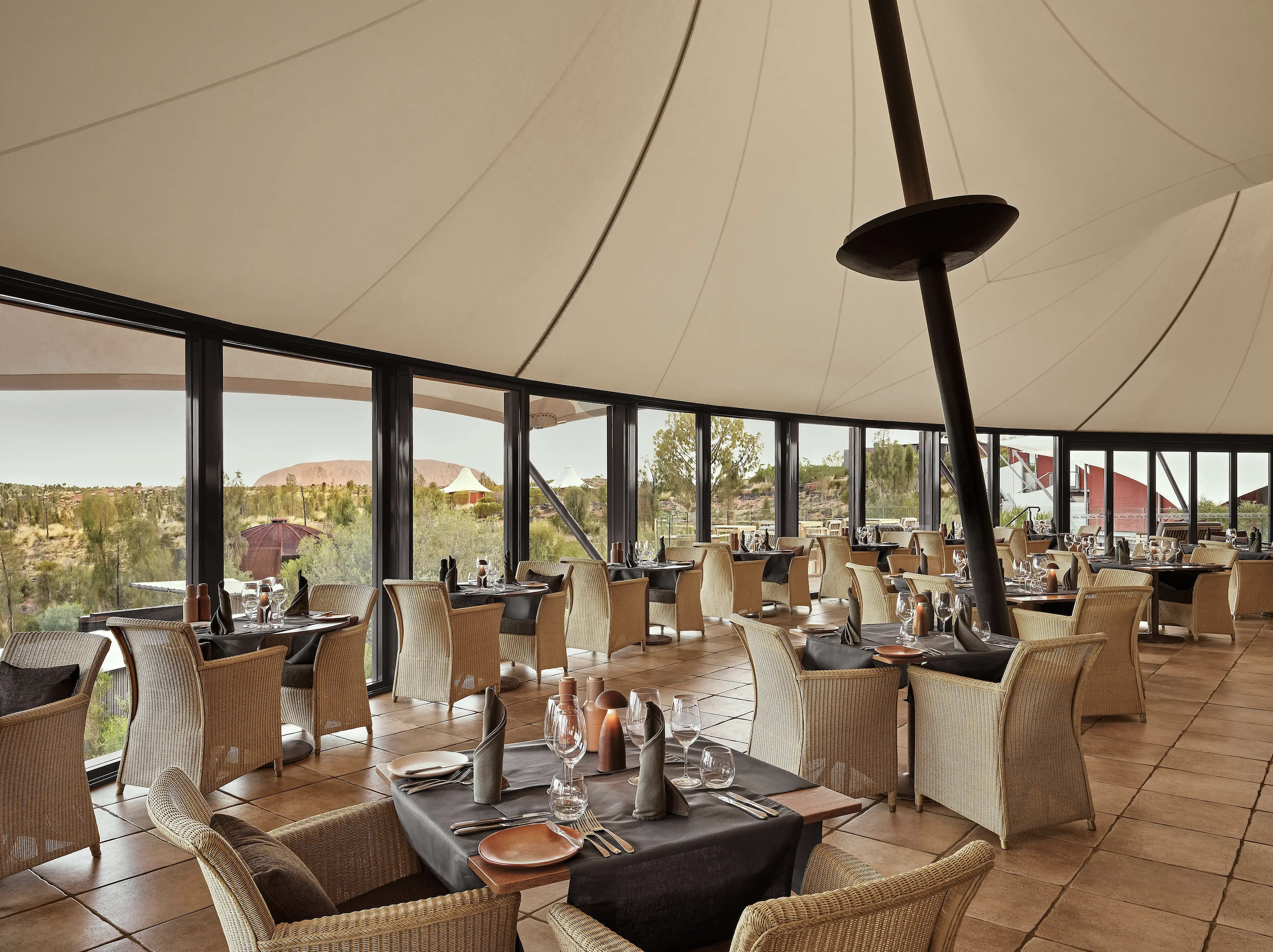
Dining is included in the Longitude 131° experience, along with most beverages and French Champagne. Menus focus on contemporary Australian cuisine, bringing premium produce from around the country into the desert and incorporating native ingredients where appropriate.
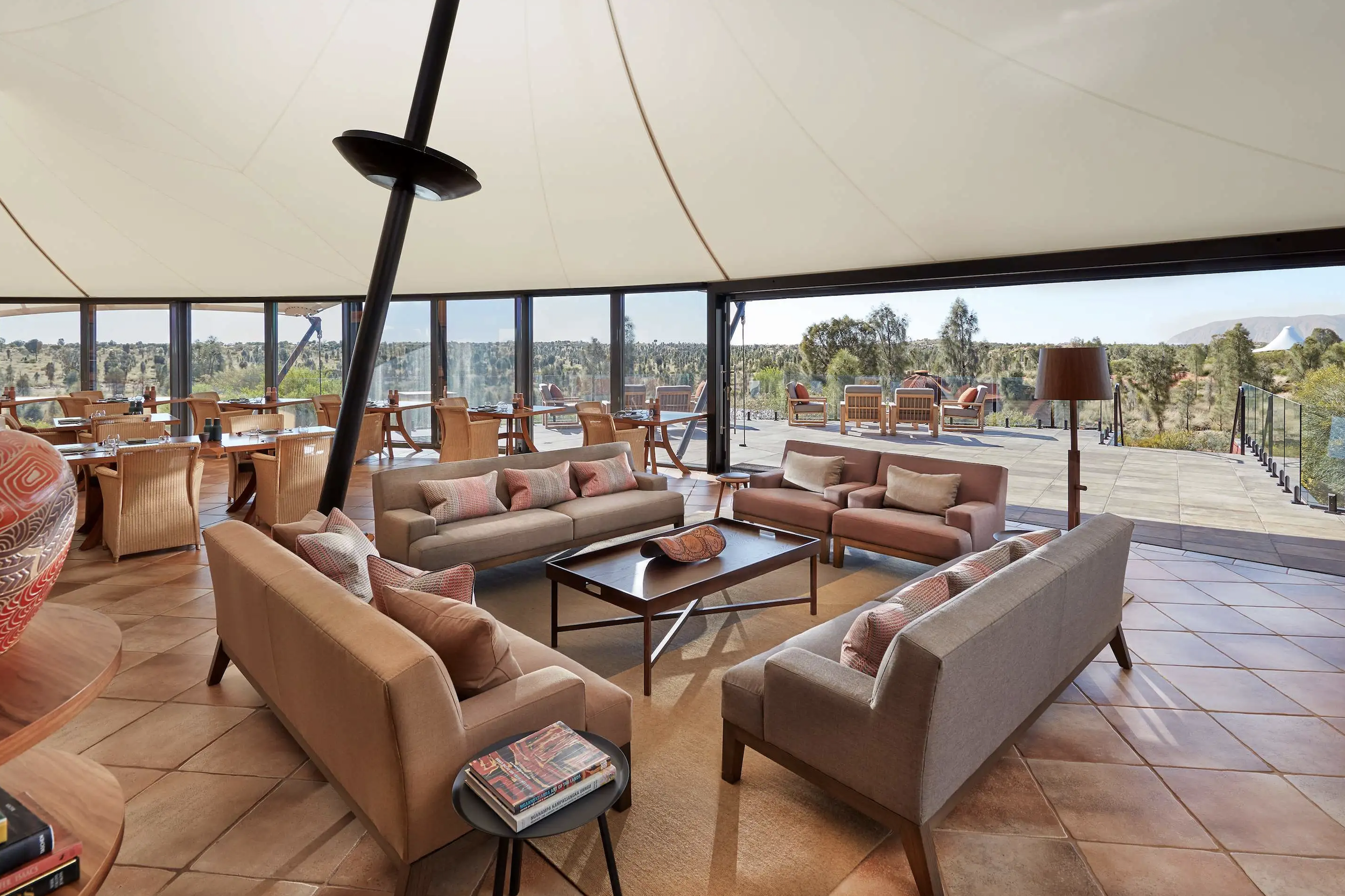
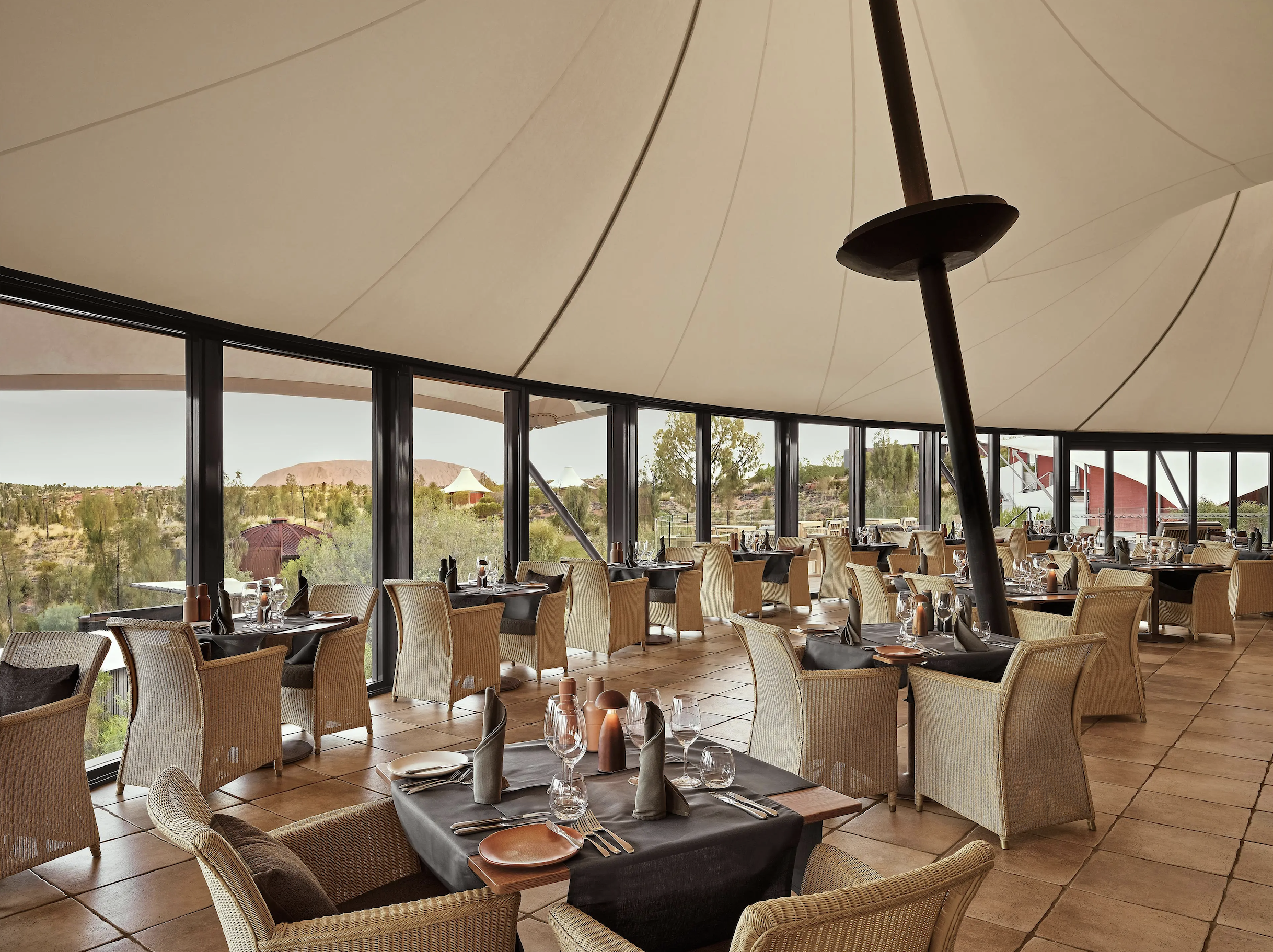
Dune House: The lodge's primary restaurant serves breakfast, lunch, and dinner overlooking Uluṟu, with changing menus centered around contemporary Australian cooking, premium regional produce, and native ingredients.
Table 131°: Longitude 131°'s signature outdoor dining experience pairs a four-course dinner and matched wines with a remote desert setting beneath the stars.
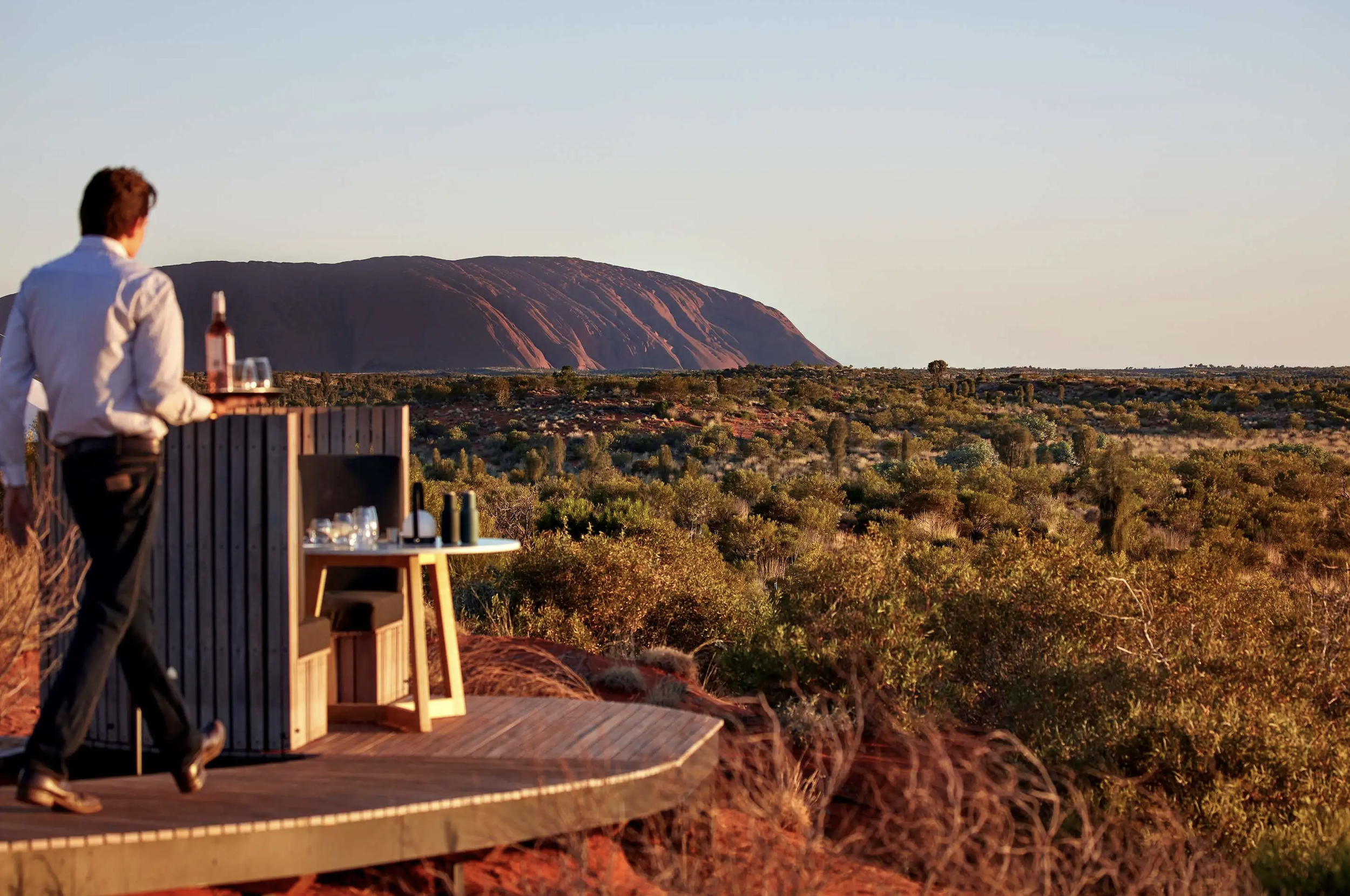
Dune Top Private Dining: Four private dining pods offer an intimate dinner with butler-style service and sunset views extending across Uluṟu and Kata Tjuṯa.
The lodge's all-inclusive approach is particularly well suited to its remote location. Rather than thinking about reservations and individual meals, dining becomes part of the rhythm of each day, shaped around sunrise excursions, afternoon downtime, sunset drinks, and evenings beneath the desert sky.
Spa Kinara and the Quiet of the Desert
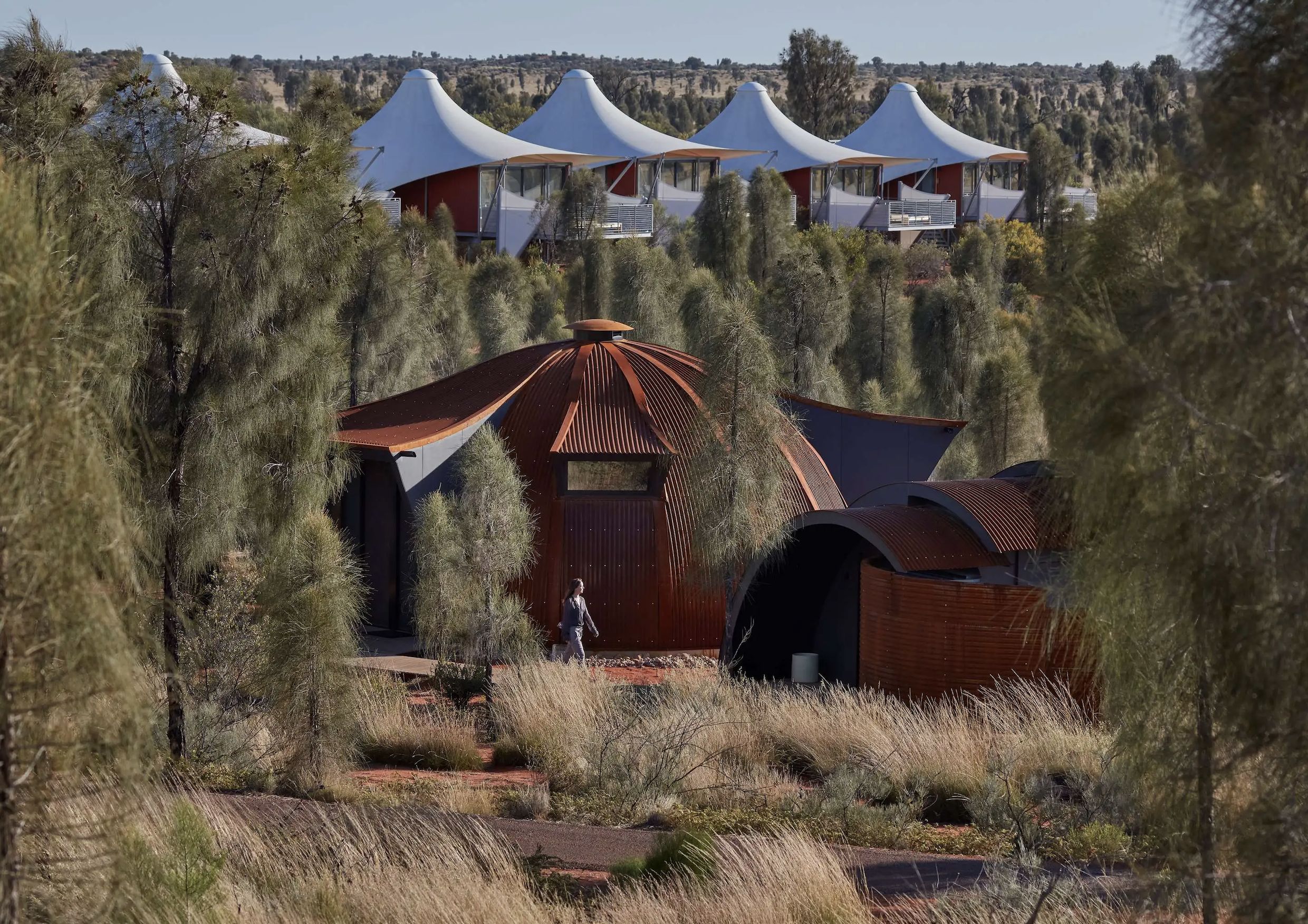
Hidden low among the dunes, Spa Kinara offers a quieter counterpoint to the early mornings and guided excursions that define much of a stay.
The architecture takes inspiration from the wiltja, a traditional Aṉangu shelter, with the building sitting low against the desert rather than rising above it. Its name, Kinara, means “moon” in Pitjantjatjara.
Treatments draw on Australian native botanicals including Kakadu plum, quandong, desert lime, scented emu bush, Australian yellow clay, and mineral-rich desert salts. The menu incorporates massages, facials, and body treatments designed primarily around relaxation and recovery after time spent exploring the national park.
There is no conventional gym at Longitude 131°, which feels appropriate given the amount of physical activity available outside. Guests looking for exercise can walk or run the lodge's five-kilometer Longitude Loop or undertake more substantial hikes within Uluṟu-Kata Tjuṯa National Park.
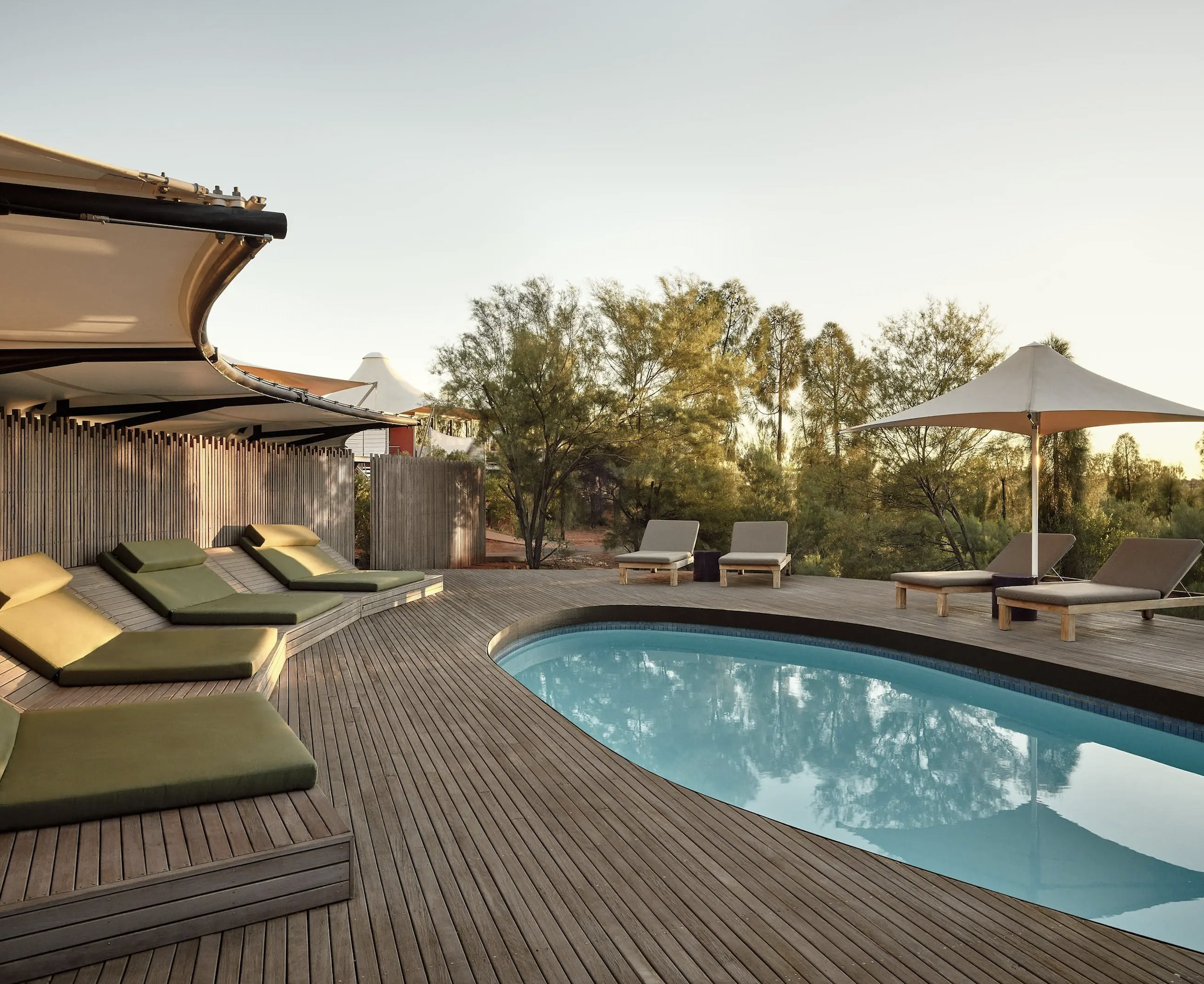
An outdoor swimming pool beside the Dune House provides a welcome retreat during warmer afternoons, while the elevated Dune Top includes a plunge spa overlooking both Uluṟu and Kata Tjuṯa.
Spa Kinara is not intended to turn Longitude 131° into a wellness resort. Its purpose is simpler: somewhere cool and quiet to retreat during the middle of the day before heading back into the desert as temperatures fall and the evening light begins to change.
Experiencing Uluṟu Beyond the Photograph
A stay at Longitude 131° is structured around getting out into the landscape.
Signature guided experiences exploring Uluṟu-Kata Tjuṯa National Park are included in the tariff and operate on an intimate shared basis, with additional bespoke and private touring available. Exact itineraries vary according to season, weather, length of stay, flight schedules, and guest preferences.
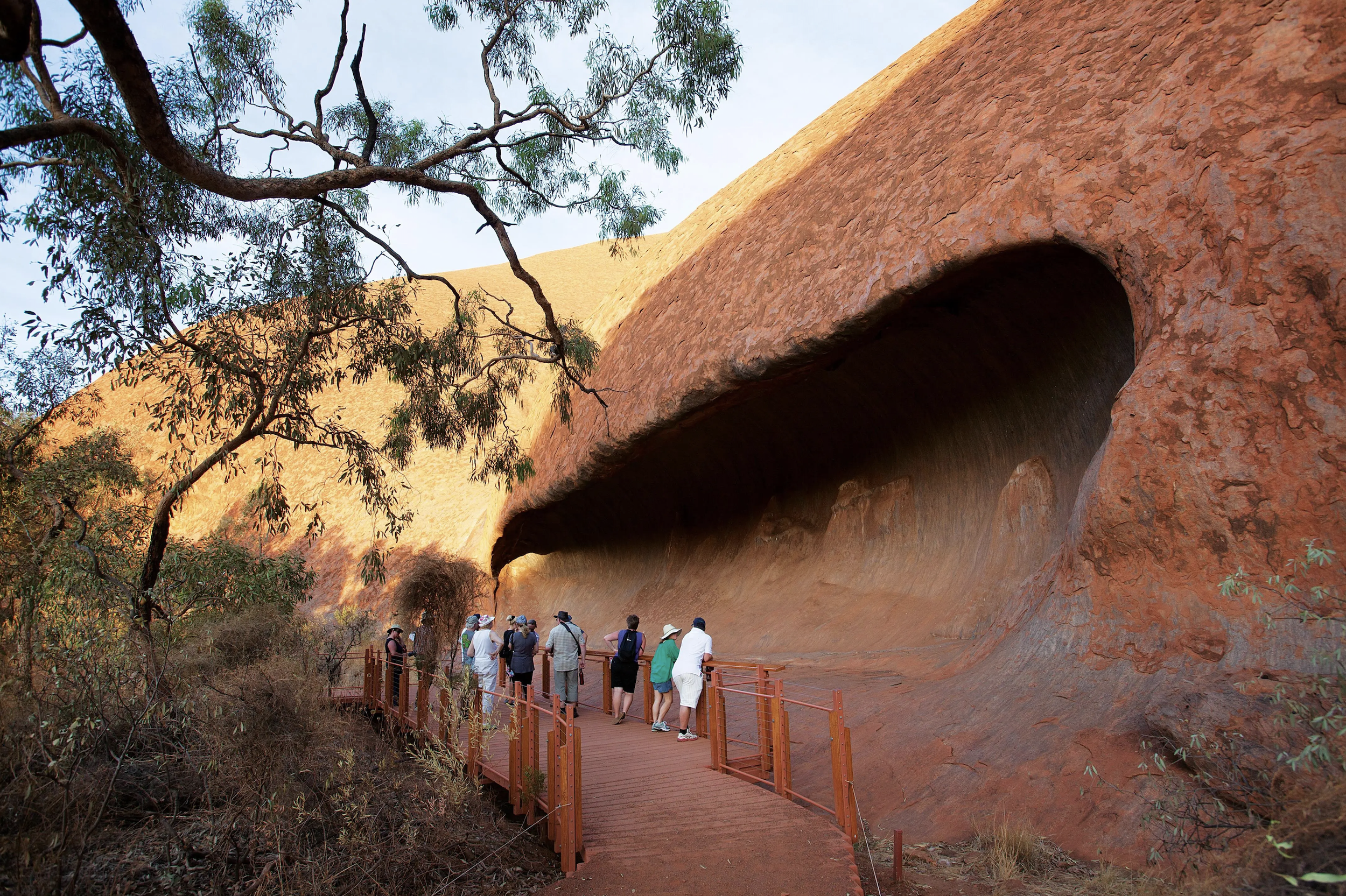
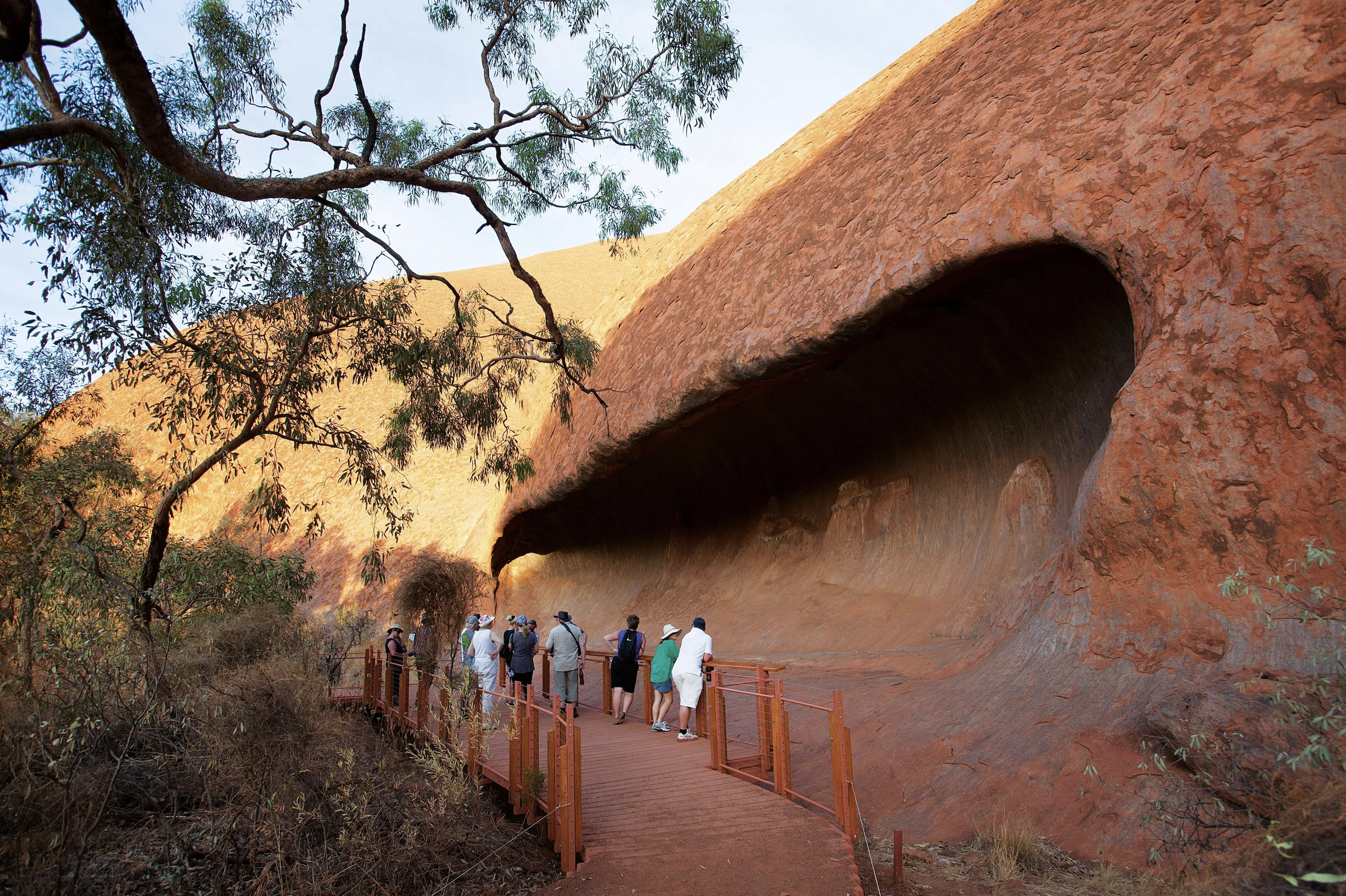
The Mala Walk and Kantju Gorge experience follows part of Uluṟu's base while introducing guests to the history and culture of the Mala people, ending within Kantju Gorge as the setting sun changes the colors of the surrounding rock.
The Mutitjulu Meander visits Mutitjulu Waterhole at the base of Uluṟu around sunrise, providing another perspective on the landscape and introducing elements of the Kuniya story that may appropriately be shared with visitors.
Kata Tjuṯa should not be treated as secondary. Located west of Uluṟu, its collection of immense domed formations creates a completely different landscape. The included Walpa Gorge and Kata Tjuṯa excursion departs around sunrise and explores the gorge before visiting the Cultural Centre.
For more active travelers, additional guided hikes include the approximately ten-kilometer Uluṟu Base Walk and the Valley of the Winds at Kata Tjuṯa.
Other bespoke experiences extend beyond walking. Scenic helicopter flights reveal the scale of Uluṟu, Kata Tjuṯa, and the surrounding desert from above, while camel experiences, private touring, and full-day adventures can be arranged for guests wanting to explore farther afield.
Longitude 131°'s relationship with Ernabella Arts also creates opportunities for a deeper understanding of contemporary Indigenous art. Artists periodically travel to the lodge as part of its artist-in-residence program, setting up within the Dune House and allowing guests to observe their work and learn more about their practice.
Some of the best hours, however, are the ones without an itinerary.
Each Luxury Tent's balcony provides a private outdoor living room facing the desert. As darkness falls, a custom Australian swag can be unfurled on the daybed, allowing guests to spend part of the evening beneath the stars.
In a landscape this powerful, leaving room to simply sit and watch it change is an experience in itself.
The Red Centre with Older Children
Longitude 131° welcomes children aged ten and older, which immediately distinguishes its family offering from a traditional resort.
There is no kids club, children's pool, or structured schedule of activities designed specifically for younger travelers. Families instead participate in the same destination-led experience as other guests.
For the right family, that can be a considerable advantage.
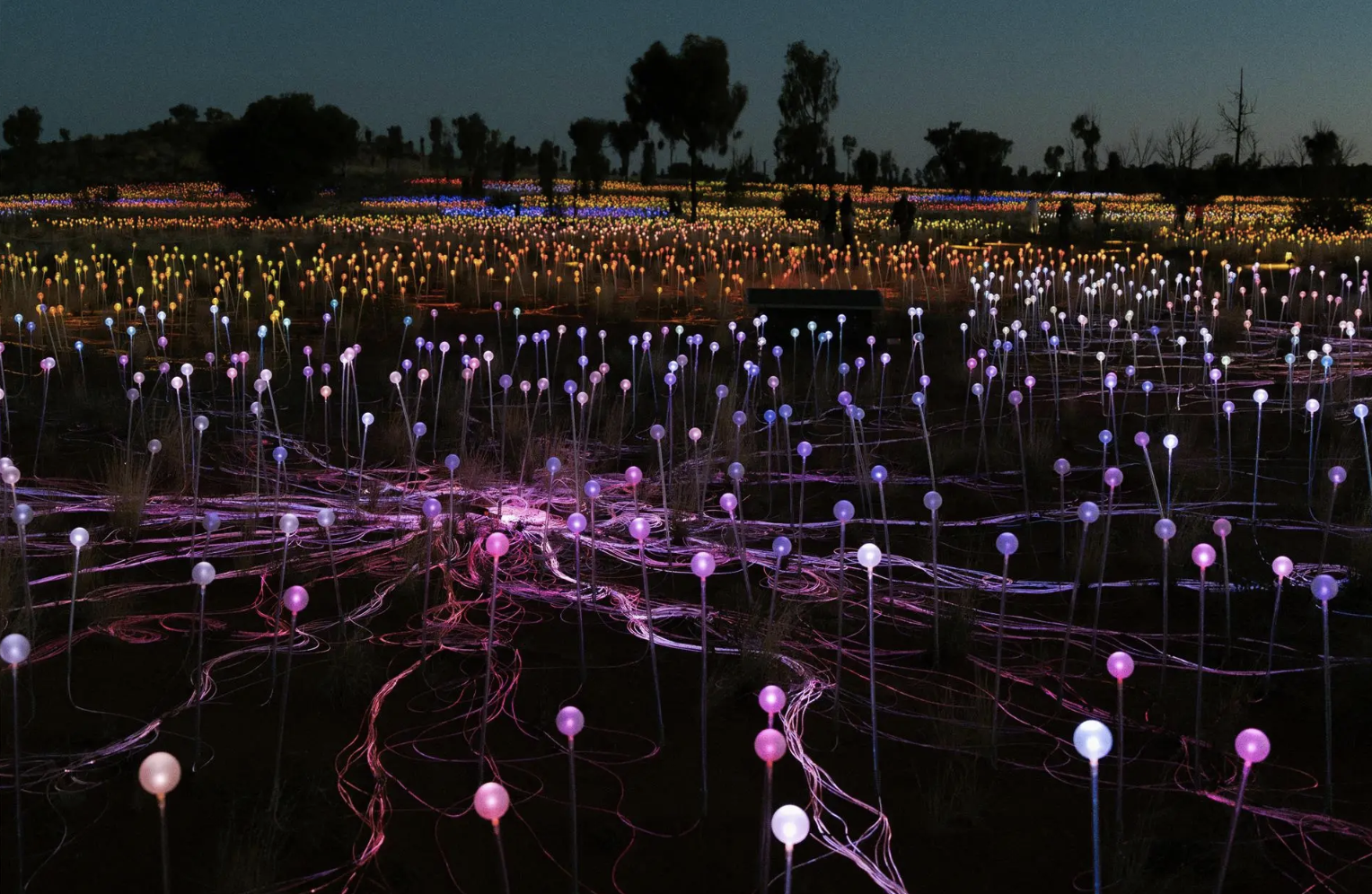
Older children and teenagers interested in nature, wildlife, Indigenous culture, hiking, geology, photography, and adventure can join guided walks through the national park, watch sunrise over Uluṟu, explore Kata Tjuṯa, sleep beneath the stars on their pavilion balcony, and experience the scale of the desert from a helicopter.
The two-bedroom Dune Pavilion is the strongest accommodation choice for families, providing separate bedrooms and bathrooms, shared living space, and a private plunge pool.
Longitude 131° therefore works best for families whose children are old enough to appreciate the destination itself. The experience is not built around entertaining children separately from their parents. It is about experiencing the Red Centre together.
Treading Lightly on the Red Dunes
Operating a high-end lodge in one of Australia's most fragile desert environments comes with obvious responsibilities, and sustainability was incorporated into Longitude 131° from its original architectural concept.
The tented pavilions and principal structures were designed to minimize their impact on the dunes. The lodge incorporates renewable energy technologies and has been conceived so that its structures can ultimately be dismantled and removed, allowing the landscape beneath them to be restored.
Longitude 131° operates under an evolving environmental management plan that addresses the realities of operating in the remote Red Centre, where water, energy, waste management, transportation, and supply chains require considerably different thinking from an urban hotel.
Its interpretation of sustainability also extends beyond environmental infrastructure.
The lodge maintains relationships with Indigenous artists and arts communities, most notably Ernabella Arts, purchasing and commissioning works while creating opportunities for artists to engage directly with guests through its residency program.
Guided experiences similarly place emphasis on understanding the cultural significance of Uluṟu-Kata Tjuṯa rather than treating the national park purely as scenery.
For Longitude 131°, protecting the destination is inseparable from the guest experience. The lodge depends entirely on the health of the landscape and the continuing strength of the culture that has cared for it for generations.
Accessibility in a Remote Desert Setting
Longitude 131° has made provisions for travelers with mobility requirements, but the remote environment and nature of the touring mean careful planning is important.
The lodge has an accessible Luxury Tent with additional bathroom aids and level access to the central Dune House. Guests with specific mobility requirements should discuss their needs with the lodge before booking so the appropriate accommodation and arrangements can be confirmed.
The greater challenge comes outside the property.
Some of Longitude 131°'s touring vehicles and certain locations within Uluṟu-Kata Tjuṯa National Park are not easily accessible to guests using wheelchairs or those with limited mobility. Walking surfaces can be uneven, distances vary considerably, and several signature experiences naturally involve desert trails.
Travelers requiring additional assistance may therefore benefit from traveling with a companion or arranging a dedicated accessible tour operator for parts of the national park experience.
Accessibility needs should be considered at the itinerary-planning stage rather than after arrival, allowing the lodge and touring partners to determine which experiences can be comfortably and safely adapted.
Getting to Longitude 131°
Longitude 131° is located near Yulara in Australia's Northern Territory, immediately outside the Uluṟu-Kata Tjuṯa National Park area. Despite the remoteness of the Red Centre, flying in is relatively straightforward, and scheduled airport transfers are included in the lodge tariff.
From Ayers Rock Airport (AYQ): Approximately 15 minutes by lodge transfer, with complimentary scheduled transfers connecting with commercial arrivals and departures.
By air from Sydney: Direct services operate to Ayers Rock Airport, with flight time generally around 3 to 3.5 hours, depending on airline and routing.
By air from Melbourne: Direct flights operate on selected schedules, generally taking approximately 3 hours, with connecting itineraries available when nonstop service does not operate.
By air from Brisbane or Cairns: Direct services operate on selected days, with additional connecting options depending on airline schedules and season.
From Kings Canyon: Approximately 3.5 hours by road, covering roughly 325 kilometers and making it possible to combine Longitude 131° with a broader exploration of the Red Centre.
From Alice Springs: Approximately 4.5 hours by road, covering roughly 445 kilometers, although flying directly into Ayers Rock Airport is considerably more convenient for travelers visiting Longitude 131° alone.
By charter aircraft: Private and charter flights can be arranged between Ayers Rock Airport, Kings Canyon, Alice Springs, and other regional airports, particularly useful when building a more complex private itinerary through Central Australia.
By self-drive: Guests arriving by car should note that private vehicles are not permitted at Longitude 131° itself. Parking is available at nearby Ayers Rock Resort, with complimentary lodge transfers arranged in advance.
Once guests arrive, the isolation becomes part of the appeal. The roads, airport, and small township of Yulara quickly disappear from view, leaving the red dunes, open sky, and unmistakable silhouette of Uluṟu on the horizon.
Australia’s Red Centre at Its Most Extraordinary
Longitude 131° succeeds because it never attempts to become more important than the landscape around it.
The accommodations are exceptional, the service polished, and the all-inclusive format makes a stay remarkably seamless given the remoteness of the destination. Yet none of those elements are ultimately the reason to travel here. They create the conditions to experience Uluṟu, Kata Tjuṯa, and the surrounding desert with enough time, comfort, and context to appreciate where you are.
That distinction makes Longitude 131° particularly valuable within a larger Australian itinerary. Sydney introduces one side of the country, the Great Barrier Reef another, and destinations such as Tasmania, Kangaroo Island, or the Kimberley reveal entirely different environments again. The Red Centre adds something that cannot be replicated along Australia's coastline: immense scale, deep cultural history, extraordinary silence, and a landscape shaped over hundreds of millions of years.
For most travelers, three nights should be considered the practical minimum. Four nights allow the experience to unfold at a more natural pace, particularly for guests interested in longer hikes, scenic flights, Spa Kinara, private touring, or simply having an afternoon without plans.
There is value in that unstructured time.
Uluṟu changes constantly with the light, and the experience of watching it from a private balcony is very different from arriving at a viewpoint, taking a photograph, and moving on. After several days, the rhythms of the desert begin to dictate the trip: early mornings, long afternoons, sunsets outside, and nights beneath a sky almost completely free from artificial light.
That is where Longitude 131° finds its purpose. It provides an extraordinary place to stay, but more importantly, it gives travelers the time and perspective to experience one of Australia's most significant landscapes as something far greater than a landmark on an itinerary.